 " alt="Industrial Onion Dehydration Processing Line: Complete Turnkey Plant Solutions">
© Henan Guoxin Machinery Manufacturing Co., Ltd. All Rights Reserved.



How do commercial dehydrated vegetable processors continuously convert fresh onions into high-grade onion flakes, granules, and powder while preserving pungent aroma, light color, and active solids? Fresh whole onions contain 85% to 88% moisture content. In industrial onion dehydration plants, processing high daily volumes requires an automated, continuous material ...
How do commercial dehydrated vegetable processors continuously convert fresh onions into high-grade onion flakes, granules, and powder while preserving pungent aroma, light color, and active solids?
Fresh whole onions contain 85% to 88% moisture content. In industrial onion dehydration plants, processing high daily volumes requires an automated, continuous material handling loop. Improper thermal treatment or uncalibrated air velocity causes sugar caramelization (browning), loss of volatile sulfur compounds (allyl propyl disulfide), and sticky surface condensation.
Guoxin Group engineers complete, industrial-grade Turnkey Onion Dehydration Processing Lines designed for continuous 24/7 operation. From automated mechanical peeling and optical-guided slicing to Continuous Multi-Tier Mesh Belt Drying Systems, our production lines process fresh raw onions into premium dehydrated onion flakes, granules, and extra-fine onion powder meeting ISO, HACCP, and global export standards.
A complete industrial fruit and vegetable production line integrates precise mechanical pre-processing with targeted hot-air continuous moisture extraction:
[Fresh Onion Intake] ──► [Top/Tail Cutting & Peeling] ──► [Air-Bubble Washing] ──►
[Precision Slicing (2-5mm)] ──► [Multi-Layer Mesh Belt Dryer] ──► [Air Cooling & Color Sorting] ──► [Milling & Packaging]
Stage 1: Raw Material Preparation & Cleaning
Automated Top/Tail & Air Peeling: High-pressure pneumatic peeling machines remove tough outer papery skins without bruising internal onion layers, minimizing edible yield loss.
Bubble Washing & Sanitization: High-pressure air-bubble washing channels flush away residual soil, roots, and surface impurities while maintaining raw tissue integrity.
Stage 2: Precision Slicing & Surface De-watering
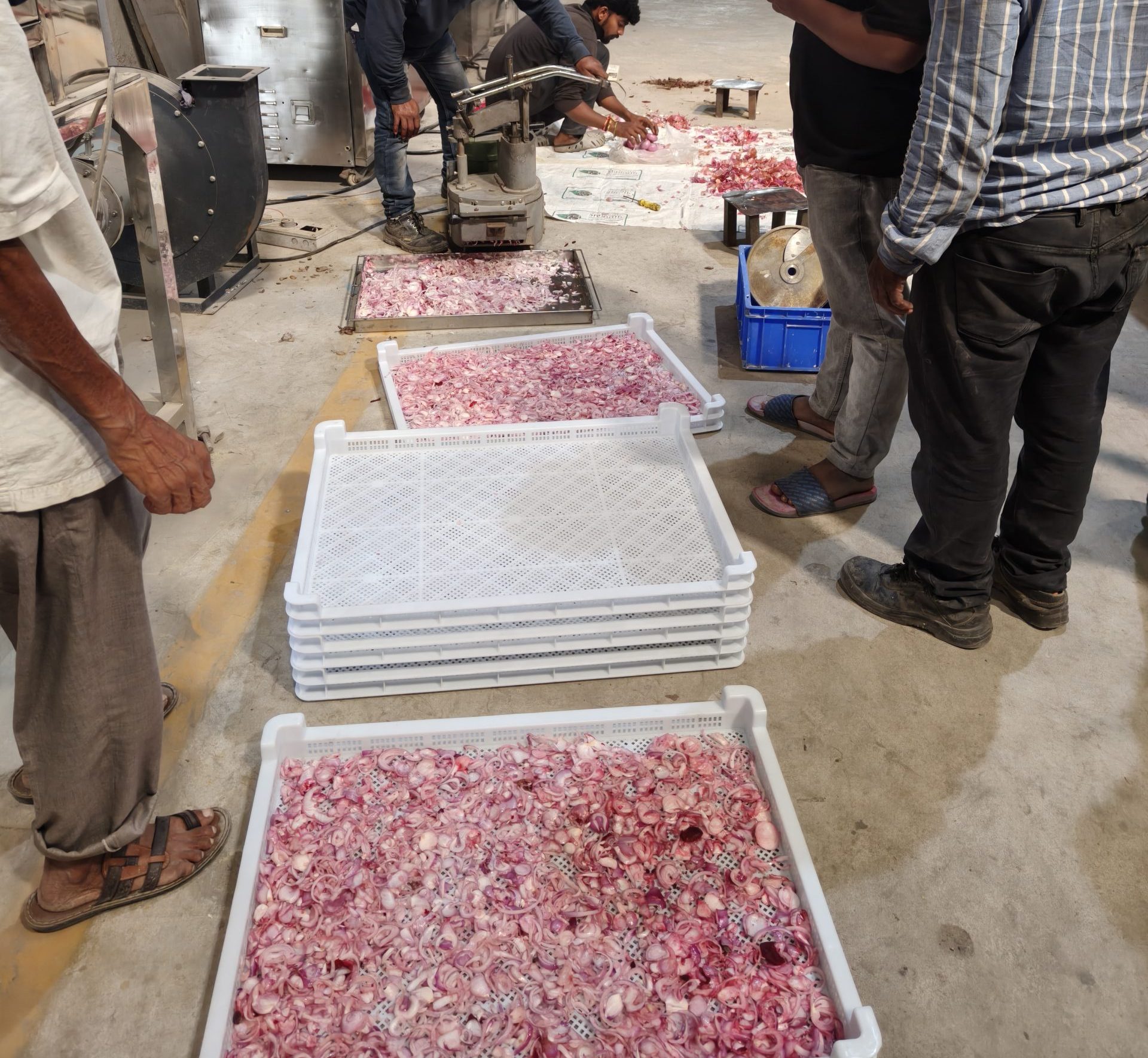
Rotary High-Speed Slicer: Cuts clean, uniform onion rings/slices (2 mm} – 5mm thickness). Uniform slice thickness is essential to prevent thin edges from scorching while thick centers remain damp.
Vibratory Air-Drying Screen: Removes free surface water droplets prior to entering the drying tunnel, reducing thermal energy requirements inside the drying chamber.
Stage 3: Multi-Zone Continuous Drying (Core System)
Cascading S-Path Travel: Material travels on stainless steel (SUS304) woven mesh belts. As onion slices fall gently between belt tiers, the bed turns automatically to ensure even 360° hot-air contact.
Zoned Thermal Control (50°C – 70°C): High-moisture entry zones utilize rapid forced convection to strip surface humidity, while finishing zones operate at lower temperatures to lock in natural white/yellow color without browning.
Stage 4: Post-Drying Sorting, Milling & Packaging
Dehumidified Air Cooling: Quickly reduces output flake temperatures to ambient levels in a controlled humidity room to prevent moisture re-absorption.
Impact Pulverizer & Sieving (For Onion Powder): Flakes destined for powder are fine-milled, cyclone-separated, and auto-packaged into moisture-proof bulk bags.
(Indexable HTML parameter matrix for complete processing line configurations)
| Plant Line Scale | Fresh Input Capacity | Final Output Flakes (<5% H₂O) | Recommended Dryer Configuration | Total Line Power | Utility Heat Options |
| Compact Processing Line | 500 kg/h – 1 Ton/h | 50 – 100 kg/h | Single-Pass / 4-Layer Mesh Belt (6m – 8m) | 35 – 55kW | Heat Pump / Natural Gas / Steam |
| Medium Commercial Plant | 2 – 5 Tons/Day | 250 – 600 kg/Day | Multi-Layer Mesh Belt System (9m – 10m) | 75 – 120 kW | Natural Gas / Steam / Biomass |
| Industrial Export Plant | 10 – 30 Tons/Day | 1.2 – 3.6 Tons/Day | Multi-Stage Continuous Line (12m – 15m) | 150 – 300+ kW | Steam Boiler / Direct Gas / Hybrid |
When evaluating the total cost of an onion dehydration plant, industrial operators must account for four critical engineering drivers:
Raw Material Conversion Ratio (~8:1 to 10:1): It requires approximately 8 to 10 kg of fresh onions to yield 1 kg of dehydrated onion flakes (<5% final moisture). Efficient line engineering reduces raw tissue waste during peeling and cutting.
Heat Source Selection (OPEX Optimizer):
Steam Heat Exchangers: Ideal for factories with existing boiler infrastructure.
Direct/Indirect Natural Gas: Fastest thermal ramp-up and clean emissions for high-tonnage continuous production.
Air Energy Heat Pump: Best for low-energy electrical operations prioritizing maximum color preservation.
Material Grade Compliance: Food-contact components constructed from SUS304/SUS316 stainless steel prevent acid corrosion from onion juices and guarantee food safety compliance.
Labor Automation Savings: Replacing manual slicing and tray loading with continuous belt conveyors reduces plant labor requirements by up to 40%–60%.
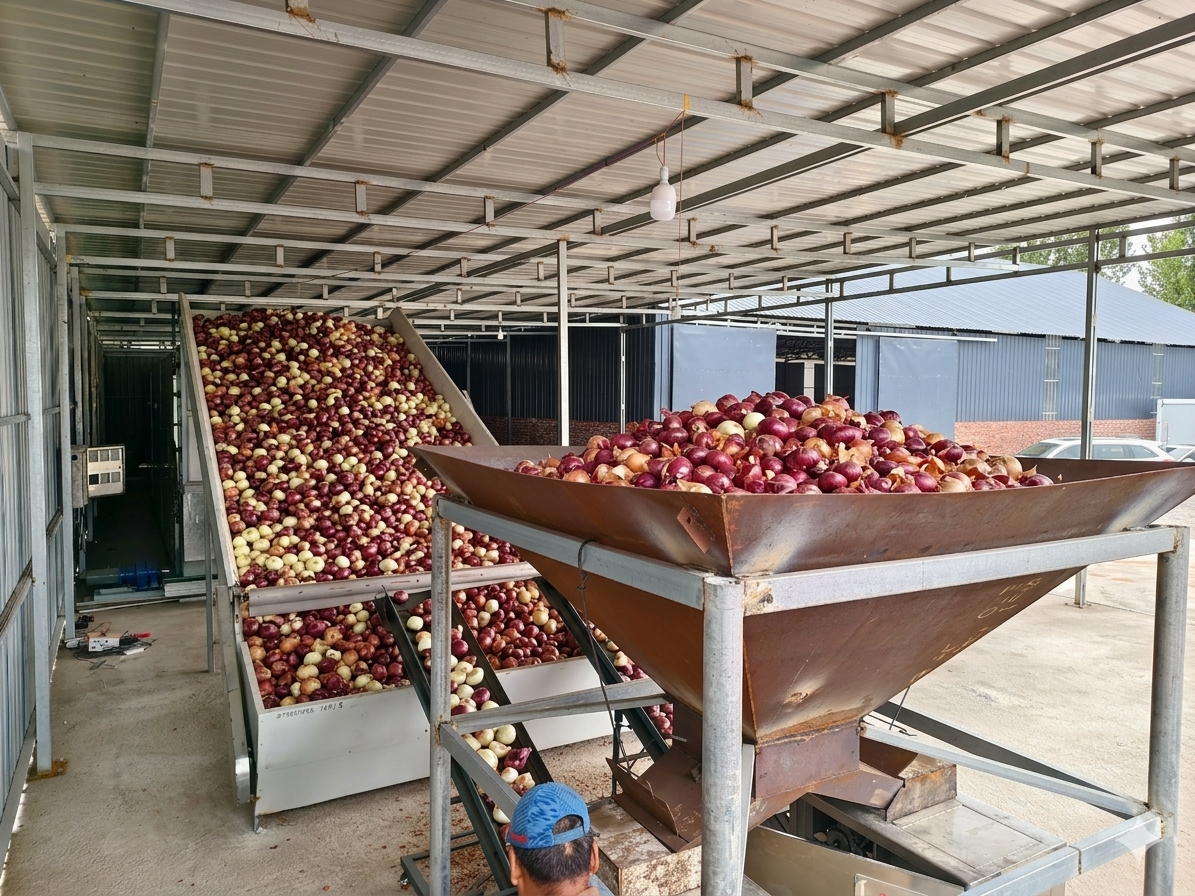
Guoxin Group designed and commissioned a turnkey 10 Tons/Day Dehydrated Onion Processing Line for a commercial food ingredient manufacturer in Gujarat, India:
Customer Processing Goal: Continuous dehydration of fresh yellow and red onions into export-ready dehydrated flakes and powder.
Line Equipment Installed: Automated Air Peeling Station ightarrow Slicing Unit rightarrow 12m Multi-Layer Continuous Mesh Belt Dryer rightarrow Cooling Winnower rightarrow Ultra-Fine Powder Milling System.
Operational Results: Reduced plant labor by 40%, stabilized product moisture under 4.5%, and maintained natural pungency and golden-white color across continuous 24-hour production shifts.
Q1: What factors determine the total equipment cost for an onion flakes manufacturing plant?
A: Plant investment costs depend on: (1) Target fresh material processing throughput (tons/day), (2) Level of pre-processing automation (manual peeling vs. pneumatic continuous peeling), (3) Selected heating utility (steam, gas, or heat pump), and (4) Secondary downstream processing (flake grading vs. fine powder milling). Contact Guoxin Group for a tailored ROI calculation and line quote.
Q2: Why is continuous mesh belt drying preferred over static tray drying rooms for commercial onion processing?
A: Static tray dryer rooms require intensive manual labor to load, turn, and unload trays, resulting in high wage overhead and uneven batch moisture. A continuous mesh belt line provides 24/7 automated material flow, uniform multi-zone thermal control, higher daily tonnage output, and complete sanitary compliance without product contamination.
Q3: How does the system control pungent sulfur odors and atmospheric moisture inside the plant?
A: Guoxin continuous onion dryers feature sealed, insulated drying cabinets with dedicated centrifugal exhaust moisture blowers. Humid, pungent air is continuously vented out of the facility or passed through air scrubbing/heat recovery units, maintaining a clean, odor-controlled factory environment.
Commercial Durian Dehydration: Preserving Quality with Heat Pump Technology
Milk Powder Drying – Parameters for Consistent Final Moisture and Functional Properties
Dehydrated Vegetables for Instant Noodle Seasoning – Drying Parameters for Consistent Quality in Seasoning Packs
Sun-Dried Tomato Drying – Parameters for Industrial Production of Consistent Tomato Slices