© Henan Guoxin Machinery Manufacturing Co., Ltd. All Rights Reserved.



Release time:2026-06-22
What is the processing efficiency and automation capability of biomass-fueled continuous onion drying lines?
Industrial continuous multi-tier mesh belt onion dehydration lines process 2,000 kg/h to 10,000 kg/h+ of fresh onions, reducing moisture content from an initial 85%–88% down to a shelf-stable 5%–7%. Utilizing automated pre-treatment and cost-effective biomass pellet burners, these systems lower net thermal energy expenses by 50% to 65% compared to traditional diesel or electrical resistance configurations.
Request Technical Specifications & Customized 3D Onion Processing Layout
This processing plant in Xingtai handles large volumes of high-moisture agricultural produce. To ensure food-safety compliance and eliminate bottlenecking, the installation features a fully synchronized, line-integrated mechanical flow:
[Bulk Raw Onions] → [Mechanical Peeling & Washing] → [High-Speed Slicing Unit] → [Inclined Conveyor Matrix] →
[Multi-Tier Continuous Mesh Belt Dryer] → [Dehydrated Onion Flakes/Shreds]
Freshly harvested bulk red onions arrive at the processing facility in high-density mesh bags. The raw onions are automatically routed through a mechanical peeling and high-pressure washing unit to strip away abrasive field soils, loose outer skins, and root debris without damaging the interior flesh.
Cleaned onions transfer directly into a heavy-duty centrifugal slicing machine. The unit cuts the bulbs into uniform shreds (typically calibrated between 3.0 mm and 5.0 mm thickness). This dimensional uniformity is critical; uneven slicing creates structural variations that lead to localized over-drying or dangerous damp cores.
The wet onion shreds feed directly onto a heavy-duty inclined flight conveyor. This conveyor lifts and spreads the material bed evenly across the top layer of the multi-tier continuous drying tunnel, eliminating manual labor and ensuring a constant mass flow rate.
Onions are highly sensitive to thermal degradation. High temperatures scorch natural fructose sugars, causing enzymatic browning that destroys the clean color matrix required by global seasoning and spice blenders.
Zone 1 (Intake Layer): 75°C – 80°C → High-Velocity Air Patented Flash Evaporation
Zone2 (Intermediate Layers): 60°C – 70°C → Managed Moisture Migration Control
Zone 3 (Discharge Layer): 50°C – 55°C → Final Equilibrium Profile Stabilization
By utilizing low-temperature, high-volume convective air circulation, the moisture moves smoothly from the core of each onion slice to the surface without causing case hardening.
The finished dehydrated product maintains its natural, vibrant color matrix with zero scorched margins or structural degradation. The output achieves a uniform moisture equilibrium of 5% to 7%, making it suitable for immediate milling into onion powder or direct bulk valve-bag sealing for international export.
The table below outlines engineered industrial configurations for Guoxin continuous multi-tier mesh belt onion processing lines.
| Technical Parameter | Model GX-ON-144 | Deployed Xingtai Model | Model GX-ON-256 |
| Daily Input Capacity | 15 to 25 Tons/Day | 35 to 50 Tons/Day | 80 to 120 Tons/Day+ |
| Effective Belt Width | 1,400 mm | 2,000 mm | 2,500 mm |
| Drying Enclosure Tiers | 4 Layers | 5 Layers | 6 Layers |
| Total Enclosure Length | 12 Meters | 16 Meters | 26 Meters |
| Primary Thermal Source | Biomass / Gas Loop | Biomass Pellet Burner | Biomass / Central Steam |
| Slicing Thickness Bounds | 2.0 mm – 8.0 mm | 3.0 mm – 5.0 mm | 2.0 mm – 8.0 mm |
| Chassis Metallurgy | Food-Grade SUS304 | Food-Grade SUS304 | Full Premium SUS304 |
| Control Architecture | Central Analog Panel | Visual Power Cabinet PLC | Full Factory SCADA Ready |
Q1: How does the biomass combustion system maintain temperature precision inside the dryer?
A: Standard manual biomass setups suffer from temperature fluctuations. Guoxin overcomes this by linking our visualized power control cabinet directly to an automated screw-feeder mechanism on the biomass burner. The PLC continuously reads internal temperature sensors across all five drying tiers. If a zone deviates by more than $\pm 0.5^{\circ}\text{C}$, the system automatically speeds up or slows down the pellet feed rate and adjusts primary induction fan dampers, ensuring a highly stable thermal field equal to automated natural gas burners.
Q2: What maintenance is required to prevent sugar buildup on the conveyor belt links?
A: Sliced onions discharge highly concentrated, sticky juices rich in natural sugars. If left unmanaged, these sugars can caramelize on the belt, blocking air paths and adhering to the product. To prevent this, our systems use high-tensile SUS304 stainless steel mesh belts with polished anti-stick surfaces. The machine frame also features built-in high-pressure internal spray bars, allowing maintenance teams to run a rapid, automated washdown sequence during shift rotations to keep the air passages clear.
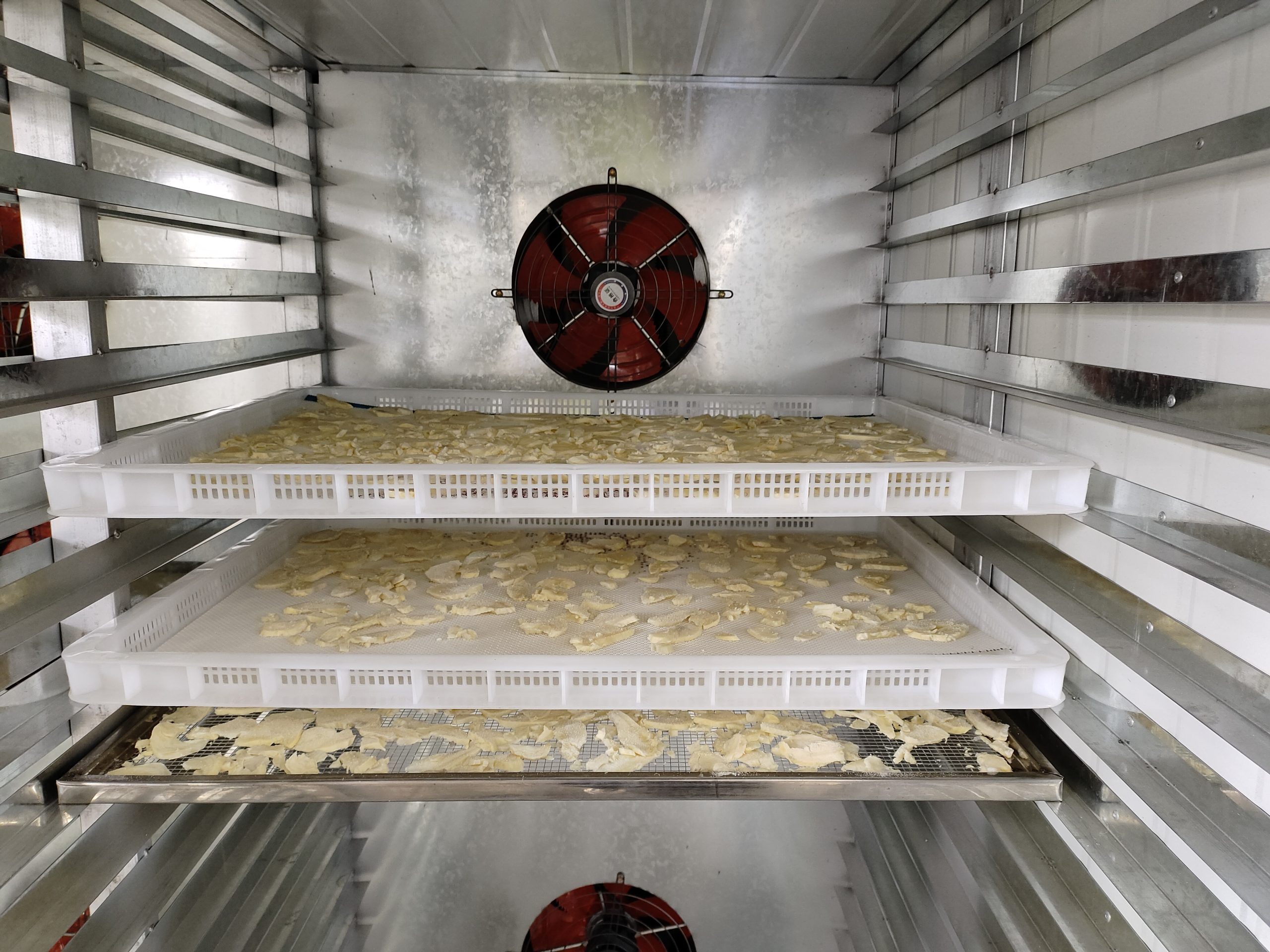
Commercial Durian Dehydration: Preserving Quality with Heat Pump Technology
Milk Powder Drying – Parameters for Consistent Final Moisture and Functional Properties
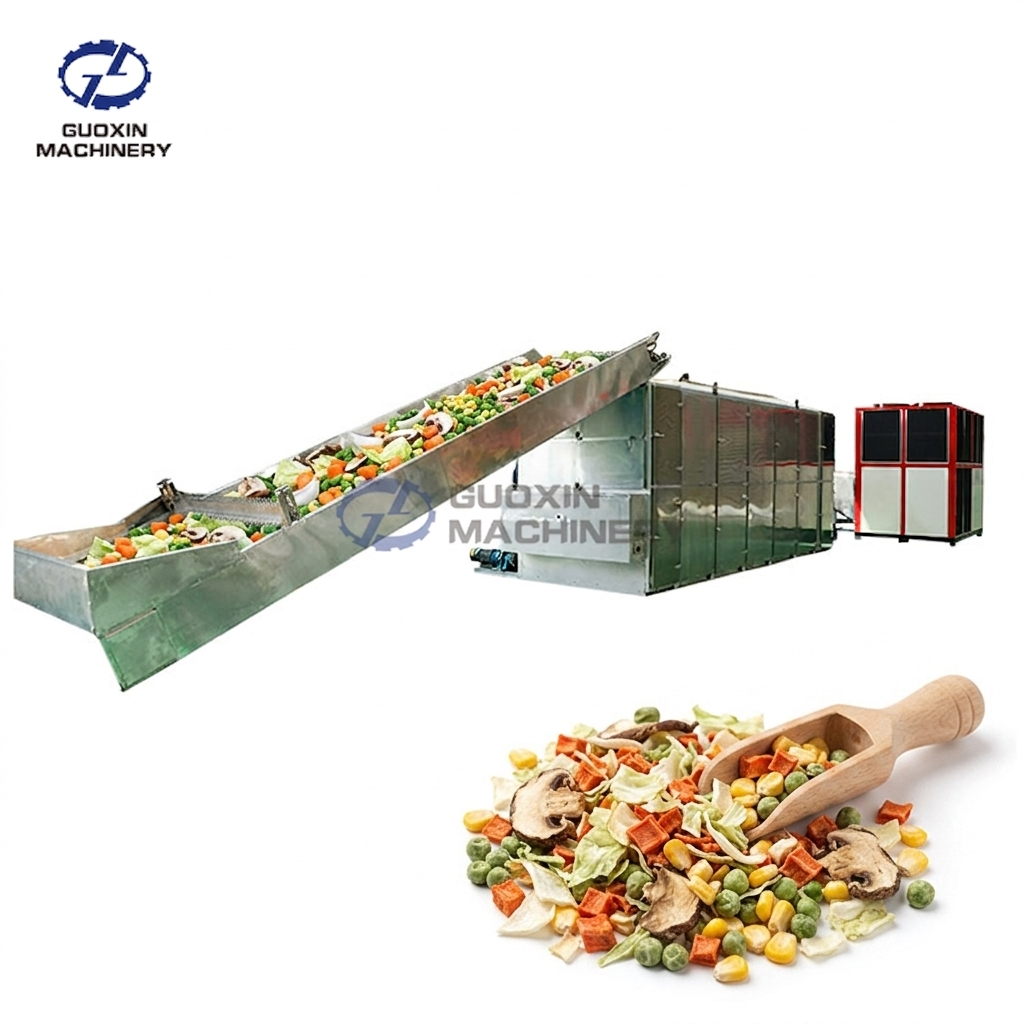
Dehydrated Vegetables for Instant Noodle Seasoning – Drying Parameters for Consistent Quality in Seasoning Packs
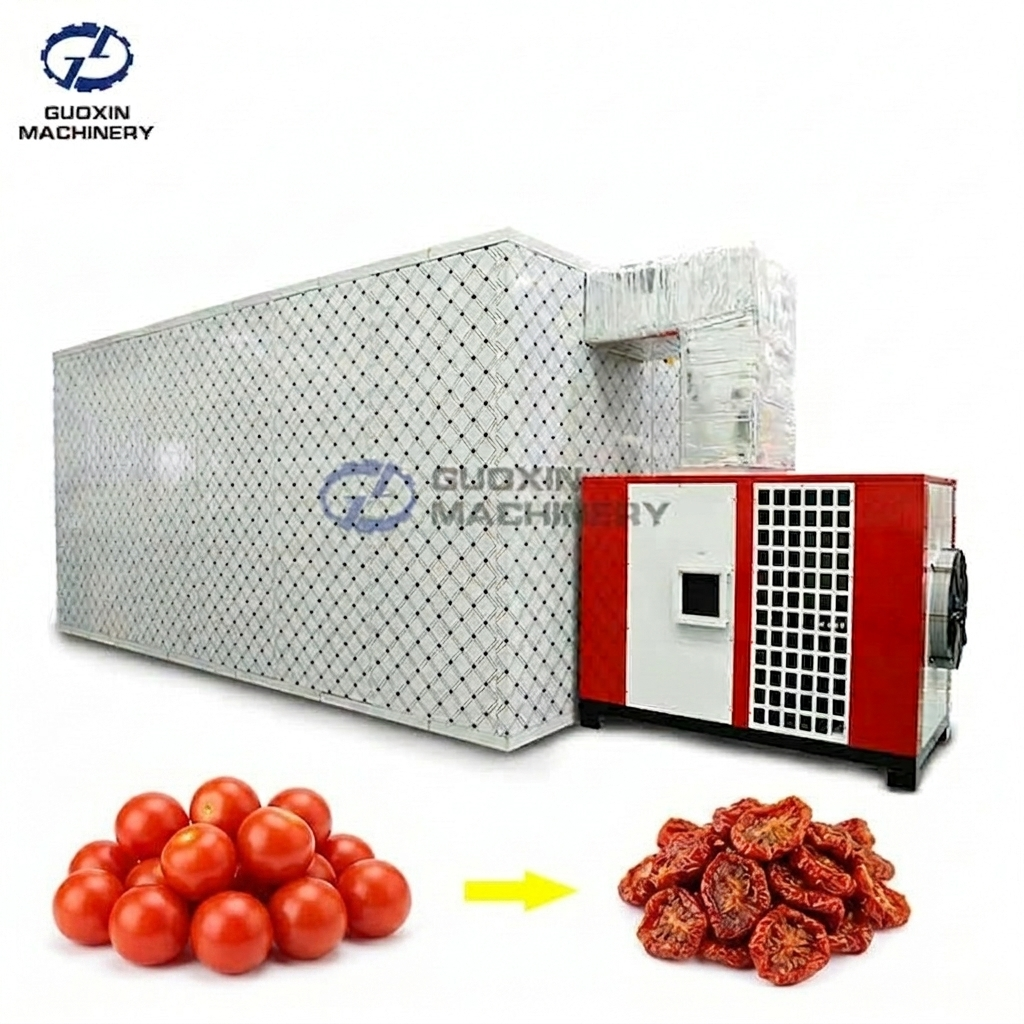
Sun-Dried Tomato Drying – Parameters for Industrial Production of Consistent Tomato Slices
Drying Coffee Beans, Cocoa Nibs and Instant Coffee Powder