© Henan Guoxin Machinery Manufacturing Co., Ltd. All Rights Reserved.



Release time:2026-06-04
Commercial heat pump pear dehydration chambers deliver a batch processing capacity of 1,000 kg to 6,000 kg per chamber cycle while operating at a Coefficient of Performance (COP) range of 3.5 to 4.2, reducing net operational electricity consumption by 60% to 70% compared to traditional direct electrical resistance heating elements.
A commercial agricultural enterprise based in Harbin, Heilongjiang Province, required an industrial-grade technological solution to process regional fresh pear (Pyrus) cultivars into premium, export-grade dehydrated fruit slices.
The climatic realities of Northeast China introduce distinct production parameters. Pears harvested in this zone feature high crispness, thick cellular matrices, and an exceptionally high initial moisture content of 82% to 86%. Pears are highly dense in fructose, glucose, and active polyphenol oxidase (PPO) enzymes.
When the cellular walls are mechanically disrupted during slicing, exposure to atmospheric oxygen triggers immediate enzymatic oxidation. If the sliced fruit is dried in conventional fossil-fuel kilns or uninsulated hot-air rooms without precise thermodynamic parameters, the sugars undergo rapid caramelization and oxidation. This turns the pear tissue a dull brown, gray, or charred black, stripping the product of its commercial premium and violating food-grade export standards.
To preserve a bright, natural translucent white-to-golden hue without relying heavily on chemical preservatives like sulfur dioxide, the integration of mechanical preparation and thermal kinetics must be structurally synchronized.
Raw Material Slicing (Centrifugal Calibration) → Uniform Tray Layering
→ Closed-Loop Dehumidification (Precise PLC Curve) → Zero-Browning Finished Product
Precision Mechanical Slicing for Dehydration Uniformity
Irregular slice thicknesses create a highly unstable drying environment where thin slices scorch and turn brittle while thick slices retain moisture cores, leading to localized mold growth during container storage.
The processing line utilizes a specialized industrial centrifugal slicing machine. The units feature calibrated, micro-ground alloy blades that cut whole washed pears into uniform slices adjustable from 3.0 mm to 7.0 mm with a mechanical thickness tolerance of pm 0.2mm.
Uniform Tray Layout Architecture
Immediately post-slicing, the material is manually arranged in a single, non-overlapping layer on food-grade SUS304 stainless steel wire-mesh trays or high-temperature BPA-free polypropylene trays. This exact distribution ensures that the convective air vectors pass evenly across the exposed surface area of every individual slice, preventing the localized wet spots that cause enzymatic yellowing.
PLC-Controlled Low-Temperature Heat Pump Kinetics
The loaded trolleys are pushed into the insulated drying chamber. The Siemens PLC system initiates a high-velocity, closed-loop air stream at 45°C to 50°C with high relative humidity extraction. This rapid initial phase flashes off the surface liquid film, lowering water activity (a_w) at the slice boundary before the PPO enzymes can execute the browning pathway.
The thermal profile is dynamically adjusted to 55°C to 65°C while relative humidity is driven down. This steady, managed gradient coaxes moisture out of the dense core of the pear without causing case hardening or sugar scorching, locking in the natural color and native nutrient structures.
For commercial fruit dehydrators, the energy required to remove water mass per kilogram is the primary metric determining wholesale profitability.
Traditional open-vent drying sheds exhaust hot, humid air out of the building, wasting huge amounts of sensible and latent thermal energy.
Guoxin’s heat pump dehydrator chambers utilize an internal refrigeration loop (evaporator, compressor, condenser). The system passes humid air across an internal evaporator coil to condense out liquid water, then re-elevates the air’s thermal value through the compressor and releases it back through the product bed.
Because the chamber operates as a sealed, heavily insulated thermal system, it does not waste energy heating cold outside air. Operational client data from the Harbin installation shows that this configuration dramatically lowers facility energy bills, offering an efficient alternative to traditional drying methods.
The table below outlines engineered industrial configurations for Guoxin heat pump fruit dehydration chambers, configured for scaled commercial operations.
| Technical Parameter | GX-HP-10 Chamber | GX-HP-30 Enterprise | GX-HP-50 Complex |
| Batch Processing Capacity | 800 kg to 1,200 kg per batch | 2,000 kg to 3,500 kg per batch | 5,000 kg to 7,000 kg+ per batch |
| Material Trolley (Rack) Count | 4 Industrial Trolleys | 10 Heavy-Duty Trolleys | 16 to 20 Custom Trolleys |
| Total Standard Tray Capacity | 96 Woven Mesh Trays | 240 Woven Mesh Trays | 480+ Woven Mesh Trays |
| Enclosure Panel Metallurgy | 100mm Polyurethane (PU) | 100mm High-Density PU | 120mm Flame-Retardant PU |
| Heat Pump Compressor Type | Copeland Scroll System | Dual Copeland Scroll Array | Heavy-Duty Industrial Reciprocating |
| Rated Electrical Power Draw | 11.5 kW | 28.5 kW | 54.0 kW |
| Air Circulation Flow Volume | 16,000 m^3/h Axial Fans | 38,000 m^3/h VFD Axials | 65,000 m^3/h SCADA Centrifugals |
| Target Temperature Range | 30°C – 75°C (± 0.5°C) | 30°C – 75°C (± 0.5°C) | 30°C – 75°C (± 0.5°C) |
| Automation Integration | Digital Programmable PLC | Siemens PLC / Touch视觉 HMI | Centralized SCADA / Profinet |
Q1: How does the heat pump chamber prevent pear slices from sticking to the trays during processing?
A: High-sugar fruits like pears naturally exude sticky fructose syrups as they warm up. If processed on rough or unpolished surfaces, the fruit can bond to the metal, causing tearing and product loss during removal. To prevent this, our processing lines use food-grade SUS304 wire-mesh trays treated with an elective electropolished smooth finish, or custom high-temperature PTFE non-stick tray liners. This ensures that the finished, dehydrated pear slices release cleanly from the tray bed without tearing, maintaining a premium whole-slice visual profile.
Q2: Why choose a batch heat pump chamber over a continuous multi-layer mesh belt dryer for pears?
A: While continuous mesh belt dryers are excellent for high-volume, chopped agricultural products (like onions or ginger), delicate sliced fruits require a static batch chamber to achieve premium appearance metrics. In a continuous belt system, the fruit drops from tier to tier while wet and sticky, which can bruise, tear, or clump the delicate pear slices together, causing uneven drying and higher scrap rates. The static chamber approach keeps the material completely motionless on individual trays throughout the entire drying cycle, ensuring zero mechanical damage and a uniform, undamaged finished product.
Q3: What are the typical capital expenditure requirements and ROI payback windows for this infrastructure?
A: Total initial capital expenditure (CapEx) depends on your required batch capacity, the choice of chamber insulation rating, and the level of automated slicing and washing pre-treatment integrated into the line. While an industrial heat pump chamber carries a higher initial cost than a simple uninsulated steam-heated room, it eliminates massive labor and energy costs by running with minimal operator oversight. Backed by a 60% to 70% reduction in electrical utility expenditures and the premium prices commanded by zero-defect export-grade fruit, commercial processors typically achieve full capital investment recovery within 14 to 20 months of plant commissioning.
Henan Guoxin Machinery partners with commercial fruit processing facilities, agricultural cooperatives, and export brands globally to verify performance metrics before manufacturing begins.
Material Testing Operations: Processors can submit regional fruit varieties to our laboratory facility to map accurate moisture-evaporation curves, sugar caramelization thresholds, and optimal tray loading densities.
Project Engineering: Provision of full 3D plant blueprints, precise electrical load charts, and factory-direct on-site installation, commissioning, and technical operator training globally.
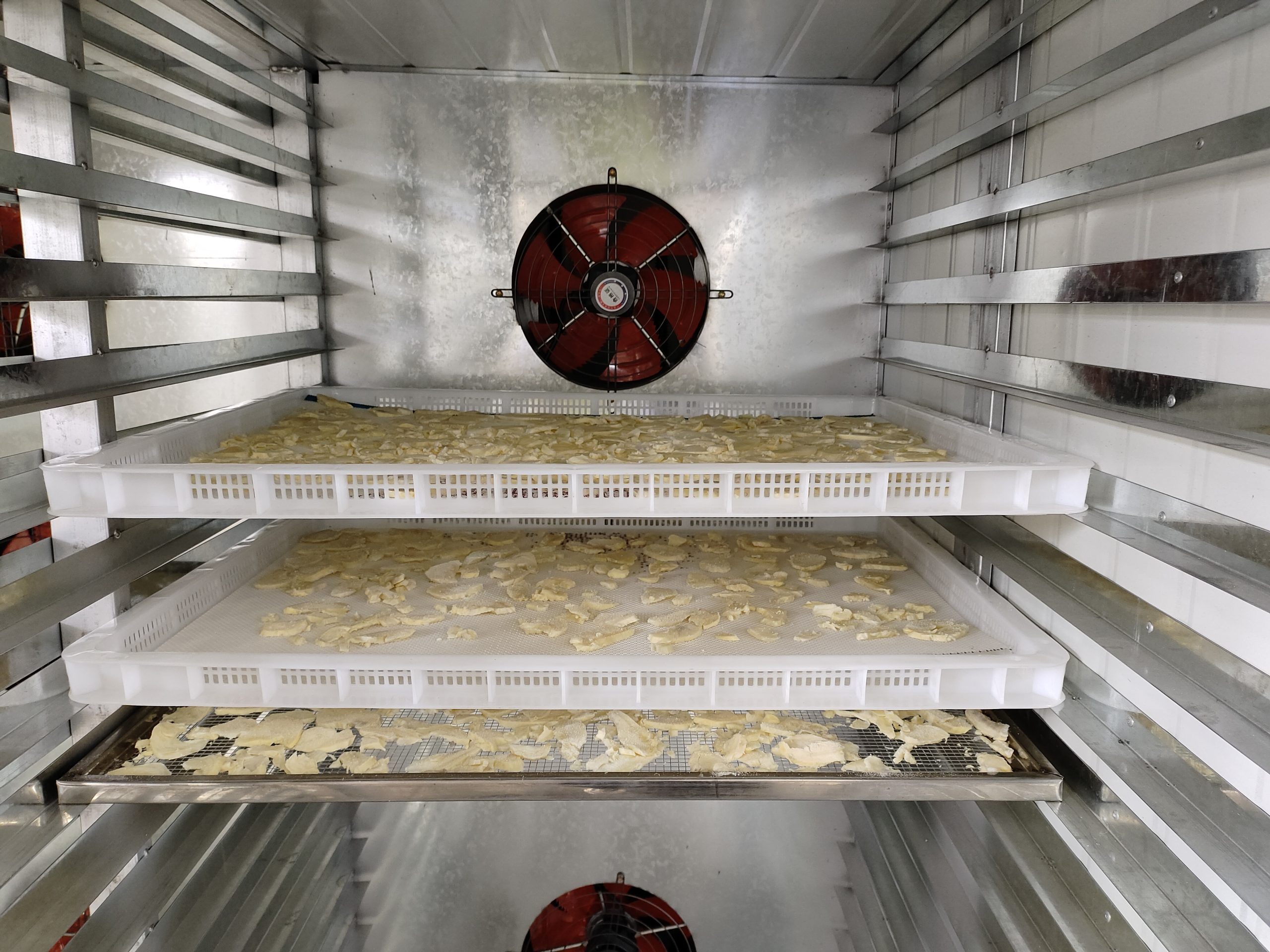
Commercial Durian Dehydration: Preserving Quality with Heat Pump Technology
Milk Powder Drying – Parameters for Consistent Final Moisture and Functional Properties
Dehydrated Vegetables for Instant Noodle Seasoning – Drying Parameters for Consistent Quality in Seasoning Packs
Sun-Dried Tomato Drying – Parameters for Industrial Production of Consistent Tomato Slices
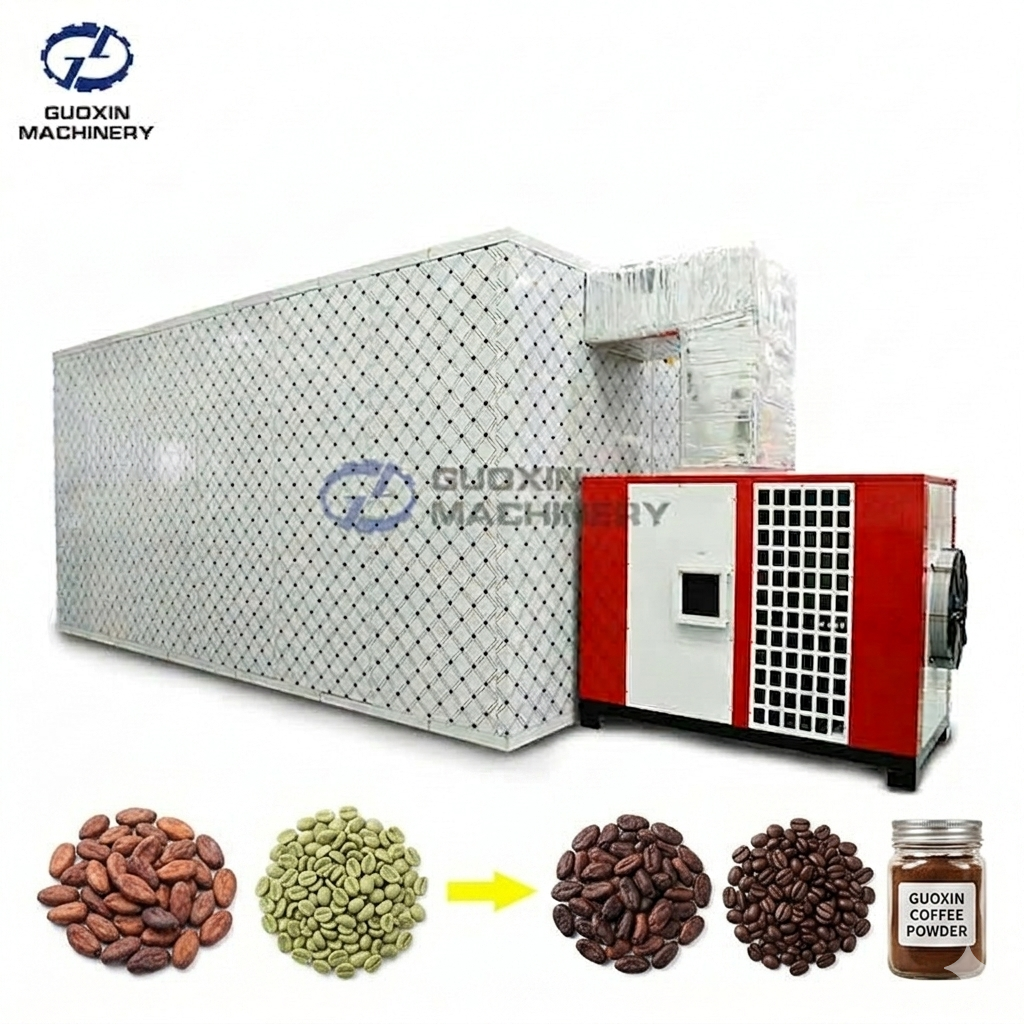
Drying Coffee Beans, Cocoa Nibs and Instant Coffee Powder