© Henan Guoxin Machinery Manufacturing Co., Ltd. All Rights Reserved.



Release time:2026-06-04
Industrial continuous multi-tier conveyor forage dehydration lines achieve a scalable production throughput from 3,000 kg/h to 20,000 kg/h+ of wet input, reducing moisture content from an unstable 70% to 75% down to a safe storage equilibrium of 12% to 14% while guaranteeing a 92% to 96% retention rate of native Crude Protein (CP) and eliminating weather-dependent field-mold risks.
Premium alfalfa (Medicago sativa), universally designated as lucerne, functions as the primary nutritional foundation for high-yield dairy cattle operations globally.
Cultivated intensively across major agricultural belts (including the United States, Southern Europe, and Central Asia), this high-yield legume concentrates substantial matrices of crude protein (typically 18% to 24% dry matter base), essential digestible fibers, carotene, and structural calcium within its leaf architecture.
The primary industrial bottleneck occurs immediately post-harvest. Freshly cut alfalfa contains an initial moisture content of 70% to 75%.
Traditional field-drying or sun-curing protocols require 3 to 5 days of atmospheric exposure. If weather fronts cause unseasonal rainfall or high ambient humidity during this vulnerable field-drying window, the damp forage canopy undergoes immediate microbial fermentation and proliferation of mycotoxigenic molds.
This biochemical degradation triggers the rapid hydrolysis of plant proteins into volatile non-protein nitrogen compounds, destroying the Relative Feed Value (RFV), causing extensive leaf shedding during mechanical raking, and rendering the final hay bales toxic or unpalatable for commercial dairy herds.
To halt the cellular degradation of harvested forage and satisfy the strict quality metrics of global animal feed importers, alfalfa must undergo rapid, controlled thermal dehydration within hours of cutting.
Field Air-Drying Layer (Weather Dependent) -> Causes Leaf Shattering &
Mycotoxin Risk Guoxin Controlled Multi-Tier Convective Airflow
-> Instant Transpiration & Leaf-Stem Equilibrium
1.Thermal Protection of the Leaf-to-Stem Moisture Gradient
Alfalfa leaves dry up to four times faster than the thick, fibrous stems. In uncalibrated rotary drum systems, the high temperatures required to drive moisture out of the stem core completely scorch the delicate leaves, causing them to shatter into dust, which strips the final product of its most protein-dense component.
Our processing lines utilize a Variable-Speed Multi-Tier Conveyor Enclosure managed by automated Siemens PLC architectures. Wet, chopped forage is distributed onto the top conveyor tier and moves through independent drying zones. The process alternates high-velocity convective air vectors vertically through the product bed. The initial high-heat zone (95°C to 115°C) rapidly vaporizes surface moisture where the leaf mass protects itself through evaporative cooling. As the material drops to the lower tiers, the temperature is stepped down to 65°C to 80°C, allowing deep internal stem moisture to transpire outward without scorching the leaf tissue or breaking the structural integrity of the plant.
2.Inactivation of Plant Respiratory Enzymes to Lock Natural Chlorophyll
Post-harvest, the plant cells remain biochemically active, continuing respiration and utilizing stored starches and proteins while activating polyphenol oxidases that turn the forage a dull, unmarketable brown.
The thermal profile of Zone 1 acts as a rapid Enzymatic Deactivation Chamber. By elevating the core leaf temperature past the enzyme denaturation threshold within the first minutes of processing, all internal cellular respiration is stopped. This locks the native chlorophyll matrix in its un-oxidized state, ensuring the dehydrated forage retains a vibrant, premium deep-green color profile that serves as a key purchasing indicator for commercial dairy operators.
In industrial-scale forage milling, the cost of thermal utilities per dry metric ton is the primary variable affecting wholesale market margins.
Traditional agricultural drying operations vent high-temperature, partially saturated air directly into the atmosphere, wasting substantial thermal energy. Guoxin’s continuous conveyor lines feature a Sensible Heat Recycling Circuit. The warm, dry air generated in the final stage cooling zone is captured and redirected into the primary burner induction plenum, reducing the energy needed to pre-heat fresh ambient air.
Our combustion chambers can be configured for a wide variety of fuel sources, including automated biomass gasification burners (utilizing local agricultural residues or low-grade straw), natural gas loops, or heavy steam heat-exchangers. This flexibility lowers operating costs, allowing processors to achieve a 45% to 60% reduction in net utility cost per metric ton compared to single-pass, uninsulated drying configurations.
Commercial forage export syndicates and feed cooperatives require integrated production engineering to maintain high capacity and avoid bottlenecking between field chopping and final packaging. Guoxin Machinery designs, manufactures, and installs complete turnkey (EPC) processing lines:
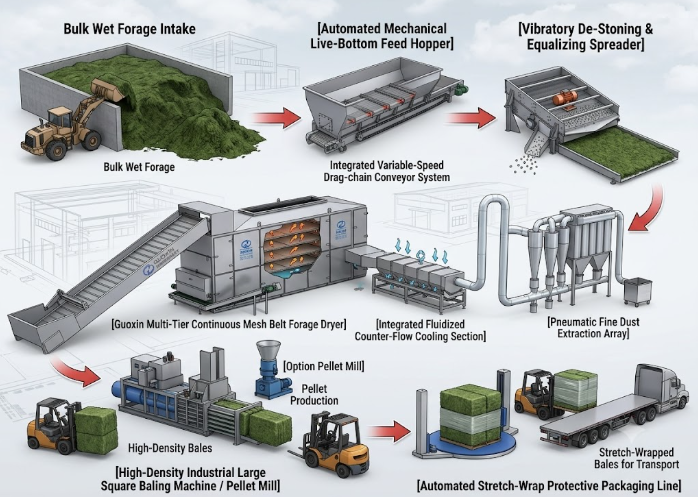
[Bulk Wet Forage Intake] → [Automated Mechanical Live-Bottom Feed Hopper] →
[Vibratory De-Stoning & Equalizing Spreader] → [Guoxin Multi-Tier Continuous Mesh Belt Dryer] →
[Integrated Fluidized Counter-Flow Cooling Section] → [Pneumatic Fine Dust Extraction Array]
→ [High-Density Industrial Large Square Baling Machine / Pellet Mill] → [Automated Stretch-Wrap Protective Packaging Line]
Removes field stones and debris while spreading dense, tangled fresh alfalfa into a uniform, loose material bed (100mm to 250mm depth) across the entire width of the dryer belt, eliminating uneven airflow channeling.
Compresses the cooled, dehydrated forage into high-density export bales (wrapped with high-tensile twine), maximizing container shipping weight efficiencies for global maritime transport.
The table below outlines engineered industrial configurations for Guoxin continuous multi-tier conveyor dehydration installations optimized for premium alfalfa forage processing.
| Operational Parameter | GX-AF-165 Continuous Line | GX-AF-226 Enterprise Plant | GX-AF-306 Industrial Complex |
| Wet Raw Input Throughput | 3,000 kg/h to 5,000 kg/h | 7,000 kg/h to 12,000 kg/h | 15,000 kg/h to 25,000 kg/h+ |
| Active Conveyor Belt Width | 2,000 mm | 2,500 mm | 3,000 mm |
| Drying Enclosure Tiers | 5 Layers | 6 Layers | 6 Layers |
| Total Drying Chamber Length | 16 Meters | 22 Meters | 30 Meters |
| Thermal Source Configurations | Biomass Burner / Natural Gas | Natural Gas / Coal-Fired Fluid Bed | Multi-Fuel Gas Arrays / Steam Loop |
| Conveyor Belt Construction | Carbon Steel / Optional SUS304 | Heavy-Duty Galvanized Mesh | High-Tensile Structural Plate Link |
| Air Circulation Drive Systems | High-Efficiency Axial Fans | Variable Frequency Drive Axials | Centralized SCADA VFD Centrifugals |
| Enclosure Insulation Rating | 80mm Rockwool (Double Wall) | 100mm Composite Fiber Panel | 120mm High-Density Thermal Barrier |
| Automation Architecture | Central Control PLC Panel | Siemens PLC / Touchscreen HMI | Complete Factory SCADA / Profinet |
Q1: How does your drying technology maintain the balance between leaf and stem moisture without causing leaf shattering?
A: Retaining the leaf mass is critical because alfalfa leaves hold over 70% of the total crude protein and carotene. Our systems resolve this through calibrated low-velocity convective airflow combined with structural multi-tier flipping. As the forage moves through the drying chamber, it gently drops from the end of one conveyor tier down to the next, reversing the material bed and breaking up air channels. Because the airflow velocity is precisely matched to the weight of the drying forage, moisture evaporates evenly from both stem and leaf without generating the harsh mechanical friction or high velocities that cause leaf shattering in rotary drum configurations.
Q2: What is the optimal factory safety protocol for managing dust and mitigating fire hazards during continuous forage drying?
A: Dehydrating dry agricultural forage creates high volumes of fine, highly combustible organic dust. To mitigate fire hazards, Guoxin roasters integrate an active Pneumatic Dust Extraction and Cyclone Separator Loop that continually pulls fine airborne particulate matter out of the active heating zones. Furthermore, the interior enclosure is fitted with real-time spark-detection sensors and automated multi-point water mist injection ports managed directly by the Siemens PLC. If an operational zone exceeds safe temperature thresholds or detects a thermal spike, the zone isolates and quenches the area instantly without stopping the primary air-circulation fans.
Q3: What are the capital expenditure requirements and typical ROI payback windows for an industrial forage processing installation?
A: Total initial capital expenditure (CapEx) varies based on the hourly wet throughput requirements, the structural choice of thermal utility (biomass gasification vs. direct gas loops), and the level of downstream packaging automation (large square export balers vs. pelleting mills). While a fully continuous multi-tier line requires a larger initial investment than basic low-capacity batch drying sheds, it removes significant manual labor costs by operating continuously with only 2 to 3 operators. Backed by a 45% to 60% reduction in fuel consumption and the premium market prices commanded by uniform, high-RFV green export bales, commercial operators typically recover their full capital investment within 14 to 24 months of plant commissioning.
Q4: How does the system adjust for variables in raw material moisture caused by daily harvesting weather shifts?
A: Freshly cut alfalfa moisture profiles shift continuously throughout the operating day—ranging from high moisture early in the morning due to dew accumulation down to lower levels by mid-afternoon. To counter this variability, our systems are built with inline microwave moisture monitoring sensors at both the intake hopper and discharge gates. These sensors stream real-time data back to the Siemens PLC. The automation software dynamically adjusts the conveyor belt tracking speed via Variable Frequency Drives (VFDs) and tunes the burner thermal output. This ensures that regardless of incoming moisture shifts, the finished forage exits the machine at a stable, uniform moisture level of 12% to 14%.
Guoxin partners with commercial forage producers, large-scale dairy integrations, and agricultural export corporations globally to verify specific process parameters before manufacturing begins.
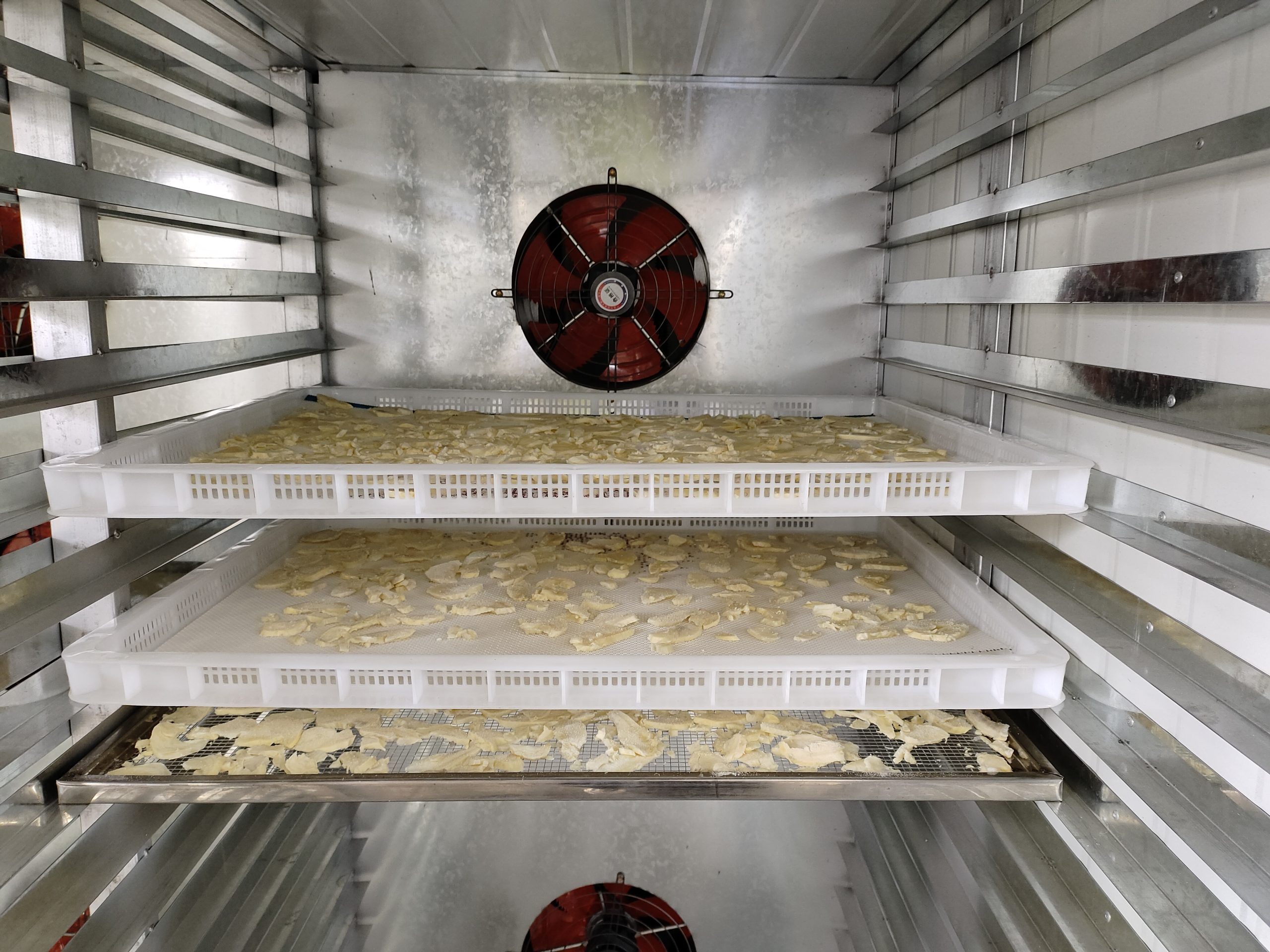
Commercial Durian Dehydration: Preserving Quality with Heat Pump Technology
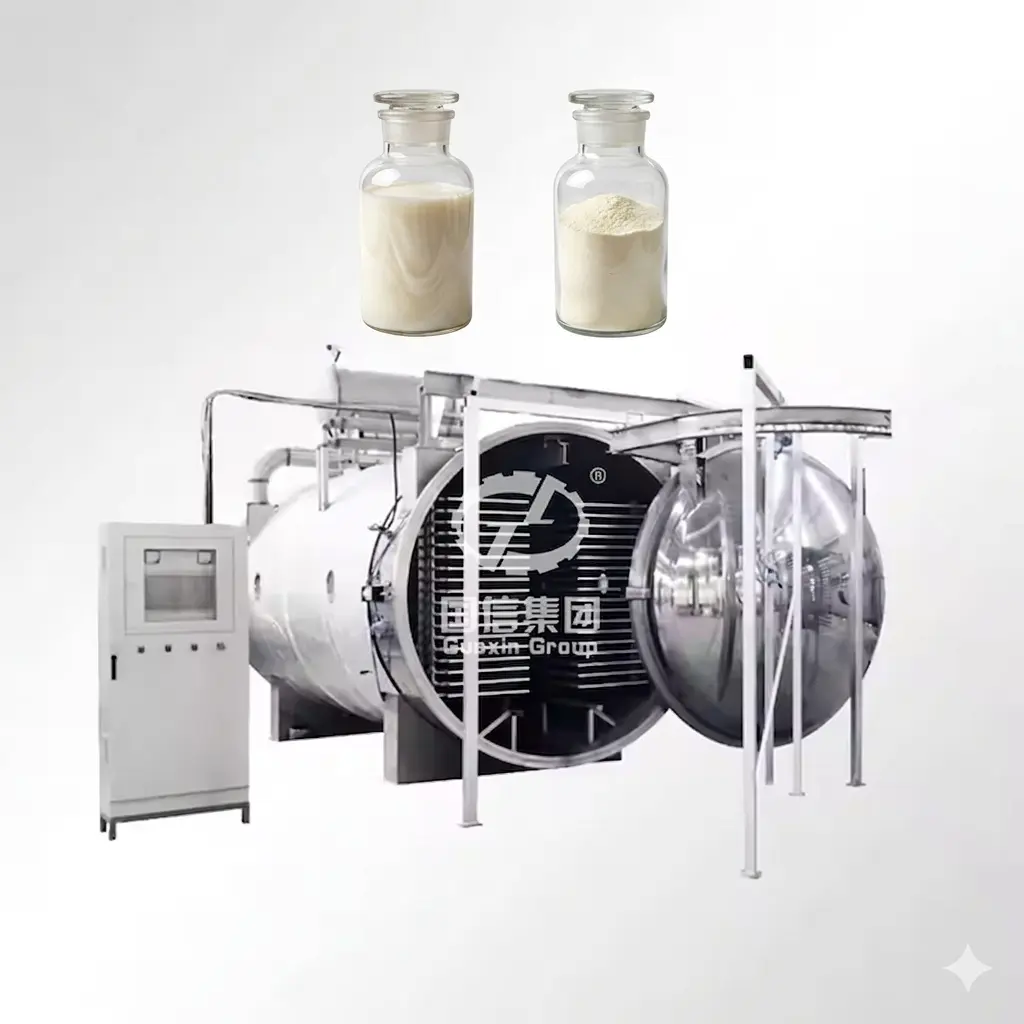
Milk Powder Drying – Parameters for Consistent Final Moisture and Functional Properties
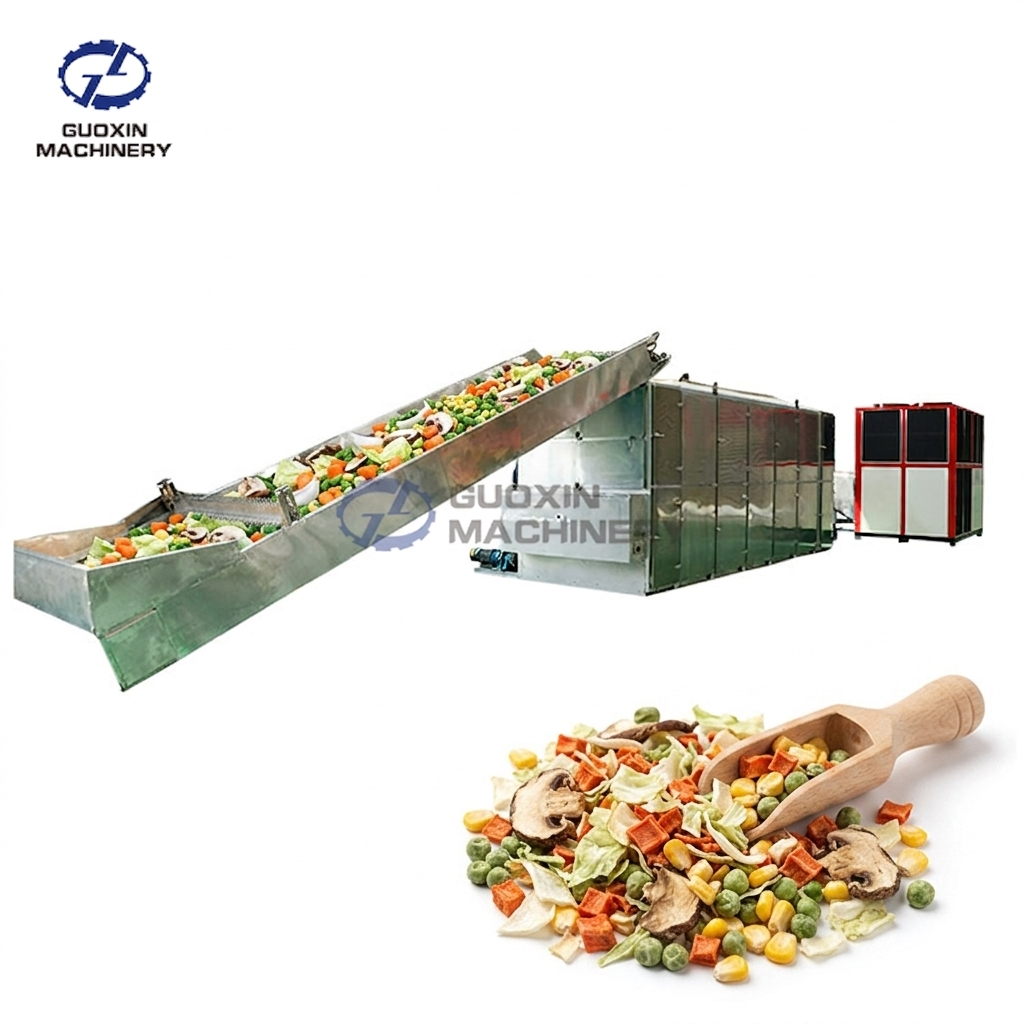
Dehydrated Vegetables for Instant Noodle Seasoning – Drying Parameters for Consistent Quality in Seasoning Packs
Sun-Dried Tomato Drying – Parameters for Industrial Production of Consistent Tomato Slices
Drying Coffee Beans, Cocoa Nibs and Instant Coffee Powder