© Henan Guoxin Machinery Manufacturing Co., Ltd. All Rights Reserved.



Release time:2026-05-19
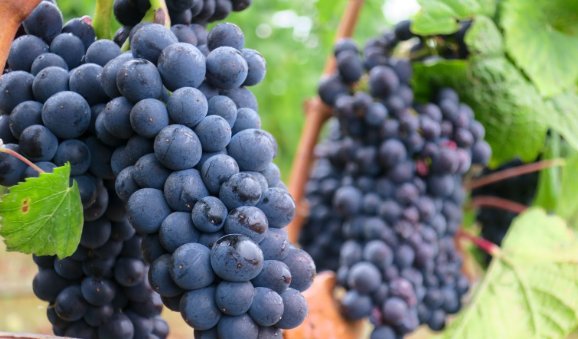
Processing raw grapes into commercial export-grade raisins requires precise moisture management to stabilize shelf life and secure premium market pricing.
Fresh grapes carry an initial moisture level of 75% to 80% trapped within a thick, waxy outer cuticle.
To satisfy international standards for bulk distribution, this moisture content must be reduced uniformly to an equilibrium of 14% to 16% while preserving the natural color, texture, and sugar integrity of the fruit.
Guoxin Machinery engineers large-scale, continuous multi-layer mesh belt drying processing lines configured specifically for industrial raisin production (including Sultanas, Thompson Seedless, and Black Currants). Our systems combine automated pre-treatment engineering with multi-stage thermal zoning to maximize throughput and eliminate the quality variables associated with traditional sun-drying methods.
Dehydrating high-sugar grapes at an enterprise scale requires specific thermodynamic adjustments to prevent structural failure of the pericarp and internal sugar degradation.
Grapes contain high concentrations of natural sugars. If exposed to sudden, intense heat or dry air at the start of the drying cycle, the internal moisture heats up rapidly, building high vapor pressure that bursts the outer skin. This leads to sugar bleeding, causing the fruit to become sticky, lose weight, and clump together on the line.
Our continuous lines feature a Multi-Stage Thermal Zone Layout managed via a centralized PLC framework.
The system splits the drying chamber into separate temperature enclosures.
The initial zone introduces medium-temperature air (60°C to 65°C) with controlled relative humidity.
This intentionally softens the waxy grape cuticle and sets up a gradual vapor pressure gradient, pulling internal moisture to the surface without breaking the skin.
As the material moves down to the lower conveyor tiers, the PLC automatically scales down temperatures to 50°C to 55°C, preventing thermal scorching and preserving a uniform amber or dark brown color profile.
Because grapes are processed in massive volumes, surface sugars can create severe adhesion issues where the fruit sticks to the conveyor, causing physical tearing at discharge and clogging the airflow paths.
The Guoxin Engineering Solution:
The drying system utilizes custom-fabricated, food-grade non-stick SUS304 stainless steel woven mesh belts.
The line integrates automated mechanical drop-transitions between the belt layers. As the raisins drop from an upper tier down to the lower tier, the material bed is naturally flipped and loosened. This constant inversion ensures that horizontal and vertical cross-flow air currents can pass evenly through the product bed, achieving an identical final moisture level across the entire batch without requiring manual labor.
The matrix below outlines the engineered industrial configurations for Guoxin continuous multi-tier conveyor drying installations optimized for large-scale raisin processing facilities.
| Operational Parameter | GX-RS-124 Continuous Line | GX-RS-205 Enterprise Plant | GX-RS-256 Industrial Complex |
| Wet Input Raw Capacity | 400 kg/h to 700 kg/h | 1,200 kg/h to 2,200 kg/h | 3,000 kg/h to 5,000 kg/h+ |
| Conveyor Belt Width | 1,200 mm | 2,000 mm | 2,500 mm |
| Drying Enclosure Tiers | 4 Layers | 5 Layers | 6 Layers |
| Total Chamber Length | 10 Meters | 14 Meters | 18 Meters |
| Thermal Source Options | Air-Source Heat Pump / Steam | Steam / Natural Gas / Heat Pump | Direct Steam Loop / Natural Gas |
| Temperature Profile Boundaries | 40°C – 75°C (PLC Managed) | 40°C – 75°C (PLC Managed) | 40°C – 75°C (PLC Managed) |
| Conveyor Material Build | Food-Grade SUS304 Mesh | Food-Grade SUS304 Mesh | Food-Grade SUS304 Mesh |
| Fan Control Array | Variable Frequency Axials | Variable Frequency Axials | Variable Frequency Axials |
| Automation Architecture | Siemens PLC / Touchscreen HMI | Siemens PLC / Touchscreen HMI | Full Siemens PLC / SCADA Ready |
For commercial food processors, thermal utility consumption represents the largest single operational variable. Our heating configurations are engineered to optimize thermal transfer efficiency and lower total cost per ton of finished product.
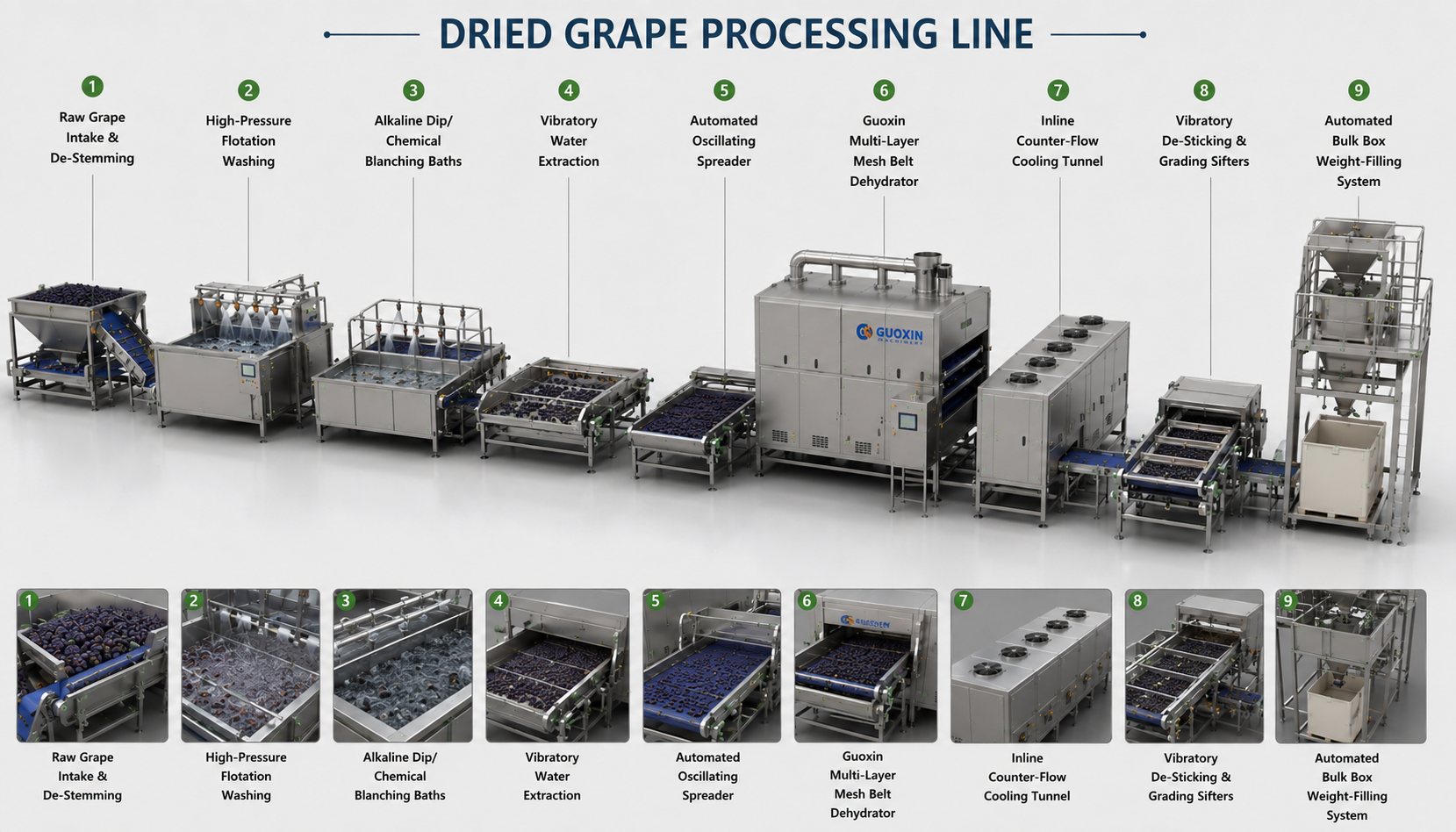
Industrial procurement managers require full production line integration to eliminate technical mismatches between equipment vendors. Guoxin Machinery engineers and delivers complete turnkey (EPC) processing pipelines, aligning all pre-treatment and post-drying systems for continuous throughput:
[Raw Grape Intake & De-Stemming] → [High-Pressure Flotation Washing] → [Alkaline Dip/Chemical Blanching Baths] → [Vibratory Water Extraction] → [Automated Oscillating Spreader] → [Guoxin Multi-Layer Mesh Belt Dehydrator] → [Inline Counter-Flow Cooling Tunnel] → [Vibratory De-Sticking & Grading Sifters] → [Automated Bulk Box Weight-Filling System]
Grapes feature a natural waxy skin layer that slows down drying times. Our turnkey lines integrate an automated dipping system that applies a mild, food-safe alkaline or oil emulsion bath before drying. This creates microscopic checks in the wax layer, reducing overall retention time inside the dryer by up to 40% without compromising fruit flavor.
Receives wet material from the de-watering screens and utilizes a mechanical oscillating arm to distribute the grapes uniformly across the width of the SUS304 conveyor belt, preventing manual piling errors.
Request a Comprehensive Turnkey Production Line Layout & Cost Estimate
Q1: How do I select the correct equipment model and belt area for an industrial raisin facility?
A: Model selection is determined by your raw input volume per hour and whether you use a chemical dipping pre-treatment. Raw grapes require between 10 to 18 hours of total processing time inside a thermal chamber depending on their size, sugar density, and skin pre-conditioning. If your factory requires an output of 20 tons of finished raisins per day, you must factor in a 4:1 moisture mass reduction, meaning the line must process approximately 80 tons of raw wet grapes daily. To maintain a thin, uniform product layer that allows optimal airflow, we configure our GX-RS-256 Industrial Complex with an extended 18-meter processing footprint to prevent overcrowding the belts.
Q2: What is the standard production line configuration for building a new raisin factory?
A: To satisfy international food safety protocols (such as HACCP or FDA audits), the plant must be separated into strict wet and dry zones. The de-stemming, washing, and dipping equipment must be located in a dedicated Wet Processing Room constructed with corrosion-resistant wash-down walls and dedicated drainage systems. The industrial raisins continuous mesh belt drying line acts as the sealed mechanical transition between these sections. The output end of the dryer must discharge directly into a positive-pressure, climate-controlled Dry Zone with a relative humidity profile below 35% to prevent the warm raisins from re-absorbing moisture before automated weight-filling occurs.
Q3: What are the capital expenditure thresholds and expected ROI payback periods for this infrastructure?
A: The total capital expenditure (CapEx) varies based on the level of mechanical automation chosen for the sorting lines and the primary thermal utility available at your site (such as boiler steam connections or local natural gas loops). While a fully automated continuous line requires a higher initial investment than old-style static drying rooms, it removes massive manual labor costs, requiring only 2 to 3 technicians to monitor the entire system from a central PLC console. Backed by a 60% to 75% drop in utility consumption and the premium prices fetched by uniform, split-free export raisins, commercial operators typically recover their full capital investment within 14 to 20 months of operation.
Q4: How does the structural design address cleaning and food-safety compliance for international export?
A: To meet the strict regulatory codes of global import markets, all product-contact areas, structural framework members, interior air baffles, and multi-tier mesh belts are fabricated from certified food-grade SUS304 stainless steel. The inner chamber uses a clean, smooth layout with radius corners to prevent organic residue or sticky sugar deposits from pooling. The entire dryer enclosure is built with large, double-sealed access panels, enabling sanitation crews to perform high-pressure chemical wash-downs and manage clean-in-place maintenance routines efficiently.
Henan Guoxin Machinery collaborates with commercial food processors and agricultural cooperatives to verify operational performance metrics before equipment fabrication begins.
Processors can submit regional grape varieties to our laboratory testing facility to determine accurate drying curves, sugar tolerance levels, and moisture diffusion parameters.
Project Engineering:
Provision of full 3D plant blueprints, precise utility integration parameters (electrical distribution, steam balancing, vacuum demands), and factory-direct on-site installation supervision globally.
Contact Our Engineering Team for a Technical Project Proposal
Commercial Durian Dehydration: Preserving Quality with Heat Pump Technology
Milk Powder Drying – Parameters for Consistent Final Moisture and Functional Properties
Dehydrated Vegetables for Instant Noodle Seasoning – Drying Parameters for Consistent Quality in Seasoning Packs
Sun-Dried Tomato Drying – Parameters for Industrial Production of Consistent Tomato Slices
Drying Coffee Beans, Cocoa Nibs and Instant Coffee Powder