© Henan Guoxin Machinery Manufacturing Co., Ltd. All Rights Reserved.



Release time:2026-06-01

What is the structural processing capacity and thermal conversion efficiency of industrial microwave quinoa and amaranth dehydration and maturation lines?
Industrial microwave grain processing systems achieve a continuous production output ranging from 500 kg/h to 6,000 kg/h+ while delivering a direct thermal energy conversion efficiency of 85% to 92%, completing dual-phase dehydration and starch maturation within a single 4-to-12-minute continuous tunnel sequence without requiring external fossil-fuel pre-heating loops.
Premium ancient whole grains, specifically Quinoa (Chenopodium quinoa) and Amaranth (Amaranthus cruentus), are traditionally cultivated in the high-altitude Andean altiplano regions of Peru and Bolivia, as well as in specialized temperate volcanic valleys worldwide.
These crops are highly adapted to low-precipitation environments, intense solar radiation gradients, and poorly aggregated alkaline soils. These stress factors cause the plants to concentrate high-density nutritional components within their small-diameter seeds (typically 1.0 mm to 2.5 mm).
These seeds feature an exceptional amino acid balance, high in lysine, functional albumins, and heat-sensitive polyunsaturated fatty acid fractions.
When processed at a commercial scale, these grain matrices present complex mechanical and thermodynamic challenges.
Raw quinoa is covered by a bitter, water-soluble outer pericarp layer composed of anti-nutritional saponins.
Eliminating these compounds requires intensive wet friction scrubbing and high-volume water rinsing. Following this pre-treatment, the wet grains carry a surface and internal moisture load of 30% to 35%.
Because of the exceptionally small mass and high surface-area-to-volume ratio of individual grains, conventional hot-air conveyor or rotary drum drying systems cause immediate surface scorching, uneven moisture distribution, blowing loss due to air velocity, and a total failure to cook or gelatinize the internal starches evenly, leaving the core raw and unstable for downstream consumer blending.
Processing premium whole grains requires uniform thermal activation throughout the seed’s structural diameter to ensure safe storage stability and immediate culinary utility.
Conventional Convective Boundary Layer (Surface Heating) -> Causes Case Hardening & Nutrient Loss.
Guoxin Volumetric Electromagnetic Energy (Core-to-Surface) -> Instant Cell Dehydration & Starch Maturation
Uniform Starch Gelatinization Without Kernel Scorching
To produce an export-grade, easily digestible grain slice or instant-cooking whole grain, the internal starches must achieve a uniform gelatinization index exceeding 85%. Conventional hot-air systems rely on external thermal conduction, which forces the outer layers of the grain to overheat and turn bitter before the thermal energy can reach the internal starch core. This creates a high percentage of immature, rock-hard kernels within the batch.
The Engineering Solution:
Our processing lines apply an Industrial Continuous Microwave Field Array operated via centralized Siemens PLC architectures. The electromagnetic wave energy directly penetrates the physical center of the moving grain bed without relying on air conduction. The internal water and polar lipid molecules within the seed core absorb this energy instantly, vibrating at millions of cycles per second. This creates a uniform thermal state from the core outward, causing immediate, homogeneous starch expansion and maturation while keeping surface temperatures below the threshold of Maillard browning or localized burning.
Rapid Inactivation of Lipase Enzymes and Complete Microbe Decontamination
Whole-grain quinoa and amaranth are highly susceptible to hydrolytic rancidity caused by active lipase enzymes, which quickly ruin shelf life and create bitter off-flavors during marine transport. Furthermore, wet-washed grains carry high total plate counts (TPC) and mold spores that must be eliminated without utilizing chemical gas fumigation.
The Engineering Solution:
The continuous microwave tunnel functions as an integrated Thermal and Non-Thermal Pasteurization System. The automated PLC control curves monitor real-time product bed conditions using multi-point infrared sensor arrays, holding the target core grain temperature precisely at 85°C to 95°C for a calibrated duration. This thermal window completely denatures the destructive lipase enzymes and disrupts the cellular walls of pathogenic bacteria, yeasts, and insect eggs. The process achieves a verified 5-log reduction in bio-burden within the same short dehydration cycle, delivering an organic-certified product ready for premium international retail packaging.
In commercial grain milling operations, managing utility expenditure per metric ton of processed input directly determines international market competitiveness.
Direct Volumetric Energy Application:
Traditional gas-fired or steam-heated rotary drum dryers must continually heat the air volume, the massive steel mass of the rotating shell, and the surrounding insulation layers, resulting in heavy thermal losses through the exhaust stacks. Guoxin industrial microwave generators convert incoming electrical energy directly into targeted electromagnetic waves that are selectively absorbed only by the moisture and starch structures within the grain bed.
Quantifiable Operating Cost Reductions:
Because zero energy is wasted heating the surrounding air or machine framework, the system operates at a highly optimized thermal efficiency level. Compared to open-vent electrical resistance band heaters or old-style diesel-fired rotary kilns, our continuous microwave lines deliver a 60% to 70% reduction in net utility cost per metric ton of processed grain, significantly reducing factory OPEX and accelerating capital investment recovery.
Enterprise grain processors and export mills require integrated production engineering to prevent material loss and eliminate mechanical mismatches between wet cleaning and dry finishing systems. Guoxin Machinery designs, manufactures, and commissions complete turnkey (EPC) processing lines, aligning all equipment for fully automated, continuous material handling:
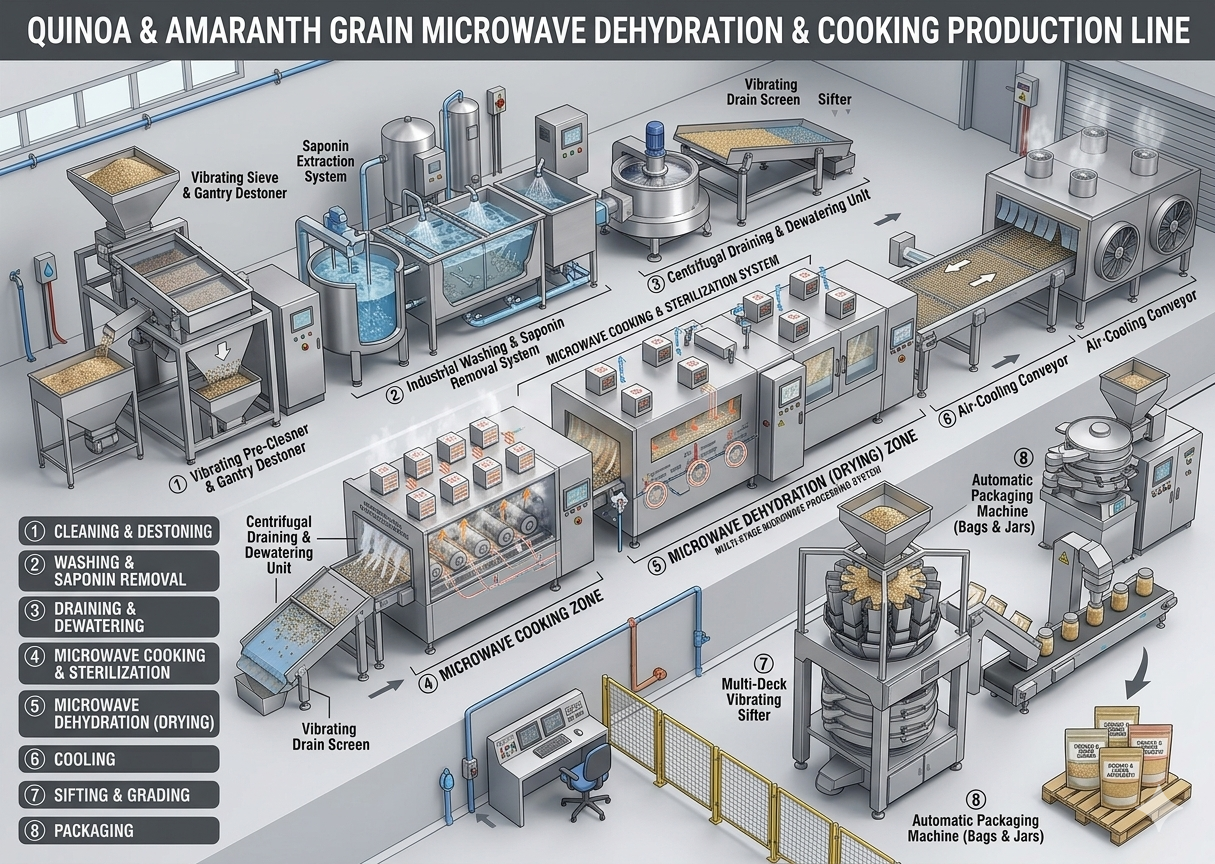
[Raw Grain Bulk Intake] → [Pneumatic Destoner & Gravity Grader] → [High-Intensity Saponin Wet Friction Scrubber] → [Multi-Stage Counter-Flow Rinse Washer] → [Continuous High-G Centrifugal Dewatering Unit] → [Vibratory Fluidized Bed Bed-Leveling Feeder] → [Continuous Microwave Dehydration & Maturation Tunnel] → [Inline Fluidized Bed Counter-Flow Cooling Unit] → [Pneumatic Fine De-Duster] → [Sorter] → [Automated Bulk Valve-Bag / Form-Fill-Seal Packaging Line]
High-Intensity Saponin Wet Friction Scrubber:
Uses mechanical friction paddles to strip the bitter outer saponin layer off the quinoa pericarp cleanly without cracking the internal seed structure.
Vibratory Fluidized Bed Bed-Leveling Feeder:
Spreads the wet, high-density grain matrix uniformly across the specialized non-stick conveyor belt at an exact, calibrated layer depth (15mm to 35mm), preventing product clumping and ensuring uniform exposure to the microwave field.
The table below outlines specific, verified industrial configurations for Guoxin continuous microwave dehydration and maturation installations.
| Operational Parameter | GX-MW-90kW Continuous Line | GX-MW-150kW Enterprise Plant | GX-MW-300kW Industrial Complex |
| Hourly Processing Capacity | 150 kg/h to 300 kg/h | 400 kg/h to 650 kg/h | 1,000 kg/h to 2,000 kg/h+ |
| Magnetron Operating Frequency | 2450 MHz (2450 MHz(± 50 MHz)) | 2450 MHz (2450 MHz(± 50 MHz)) | 915 MHz Heavy-Duty Industrial |
| Rated Microwave Power Output | 90 kW (0-100% Linear Tuning) | 150 kW (0-100% Linear Tuning) | 300 kW (0-100% Linear Tuning) |
| Conveyor Belt Width | 1,000 mm | 1,200 mm | 1,600 mm |
| Active Tunnel Length | 14 Meters | 18 Meters | 28 Meters |
| Conveyor Belt Build Material | Food-Grade High-Temp Kevlar / Mesh | Food-Grade High-Temp Kevlar / Mesh | Specialized Non-Stick Industrial Structure |
| Temperature Detection Array | Multi-Point Infrared Pyrometers | Multi-Point Infrared Pyrometers | Continuous SCADA Scanning Infrared Array |
| Microwave Leakage Emission | < 1 mW/cm^2(Exceeds OSHA) | < 1mW/cm^2 (Exceeds OSHA) | < 1 mW/cm^2(Exceeds OSHA) |
| Structural Control Interface | Siemens PLC / Touchscreen HMI | Siemens PLC / Touchscreen HMI | Central Control SCADA / Profinet Link |
Q1: How does your system prevent grain leakage and loss when transporting small-diameter seeds like amaranth?
A: Our continuous microwave tunnels utilize a customized, high-density woven Kevlar-reinforced composite belt engineered with continuous, sealed vertical side curtains. This design forms a tight physical trough that prevents ultra-fine grains (down to 0.8 mm) from slipping off the conveyor edges into the microwave guide structures. Additionally, the transition points between the vibratory leveling feeders and the main conveyor use precision zero-clearance polymer scrapers, ensuring 100% material containment and eliminating mechanical product loss throughout the entire drying cycle.
Q2: What is the recommended factory layout for passing global food safety and organic certification audits?
A: To satisfy rigorous international standards (including HACCP, BRC, and organic trade certifications), the facility must enforce a strict sanitation barrier separating wet and dry operations. The wet pre-treatment modules (saponin scrubbing, rinsing, and centrifugal dewatering) are isolated within a dedicated “Wet Processing Zone” built with corrosion-resistant wash-down walls and dedicated floor drainage. The industrial microwave dehydration & maturation tunnel acts as the continuous sealed wall transition. Because the grains emerge from the tunnel fully sterile and matured, the discharge end outputs directly into a positive-pressure, HEPA-filtered “Class 100,000 Clean Dry Zone” running ambient relative humidity below 30% to prevent the warm, processed grains from re-absorbing atmospheric moisture before packaging.
Q3: What are the capital expenditure thresholds and verified ROI payback periods for this infrastructure?
A: Total initial capital expenditure (CapEx) depends on the required microwave power capacity and the level of downstream automation chosen (such as automated optical color sorting systems or robotic bagging lines). While a fully continuous microwave line represents a higher initial investment than basic agricultural hot-air trays, it eliminates massive manual labor costs, requiring only 1 to 2 operators to manage the entire sequence from a central PLC terminal. Factoring in the 60% to 70% reduction in utility energy consumption, the complete elimination of batch rejection rates, and the premium prices fetched by certified pathogen-free whole grains, commercial operators typically achieve full capital investment recovery within 12 to 18 months of commissioning.
Q4: How does the equipment suppress microwave leakage to ensure plant operator safety?
A: Our continuous industrial tunnels are engineered with advanced, multi-stage structural suppression chambers at both the inlet and outlet gates. These microwave suppression zones utilize geometry-tuned chokes and advanced absorbing materials to trap stray electromagnetic waves completely. The entire enclosure is built with heavy-duty, double-shielded inspection panels equipped with automatic safety-interlock switches that instantly terminate magnetron power if a door is opened during operation. Verified leakage levels remain below $1\text{ mW/cm}^2$ measured at any point, comfortably exceeding FDA, OSHA, and European CE safety directives.
Henan Guoxin Machinery collaborates with international grain millers, bulk agricultural exporters, and functional food brands to verify performance metrics prior to equipment manufacturing.
Material Testing Operations:
Industrial processors can ship regional grain samples to our testing facility to establish accurate dielectric loss factors, precise starch expansion curves, and nutrient retention profiles.
Project Engineering:
Provision of full 3D plant blueprints, structural utility load charts (electrical distribution, wastewater drainage lines), and factory-direct on-site installation, commissioning, and technical operator training globally.
Contact Our Industrial Engineering Division for Technical Consultations
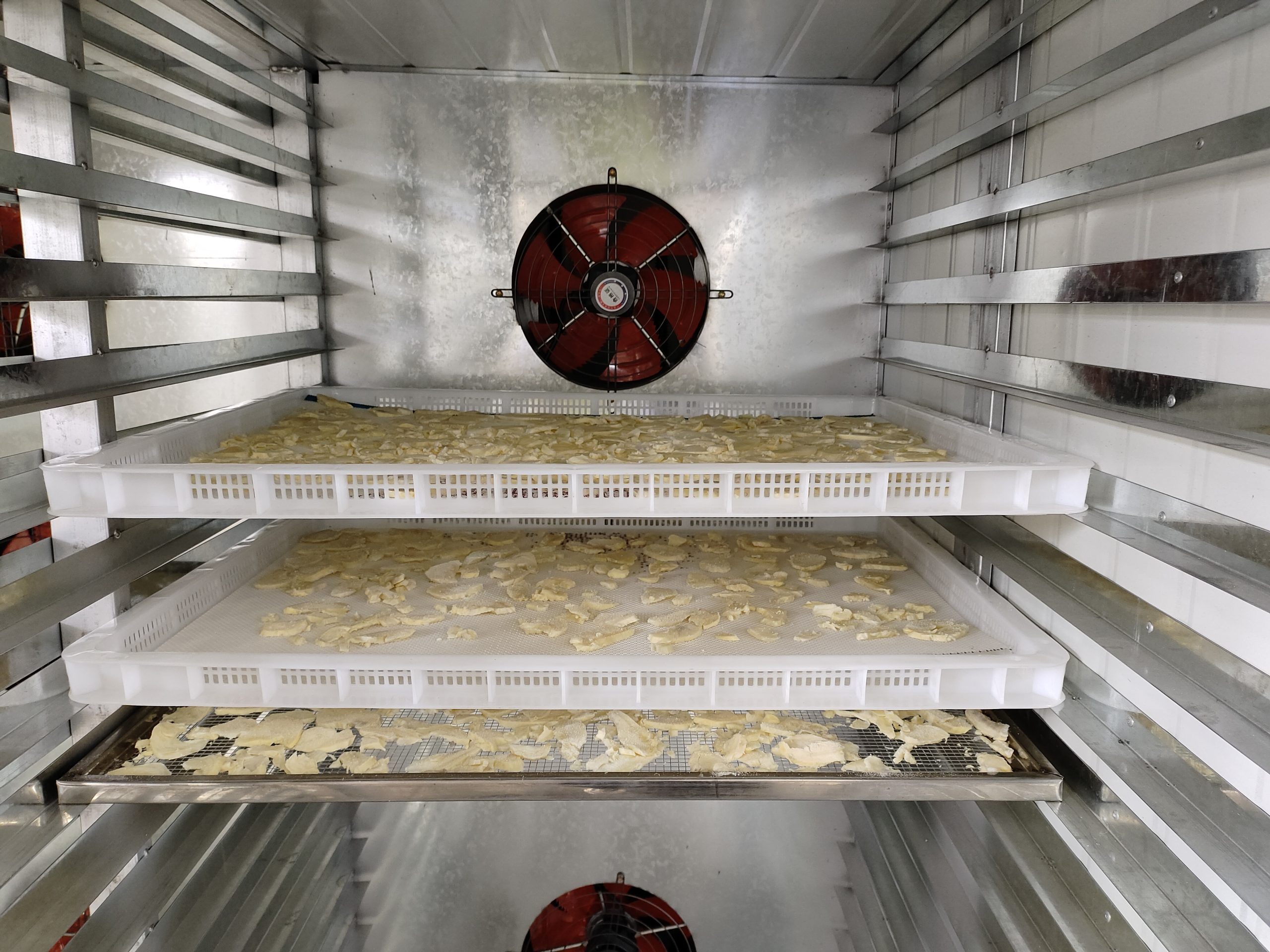
Commercial Durian Dehydration: Preserving Quality with Heat Pump Technology
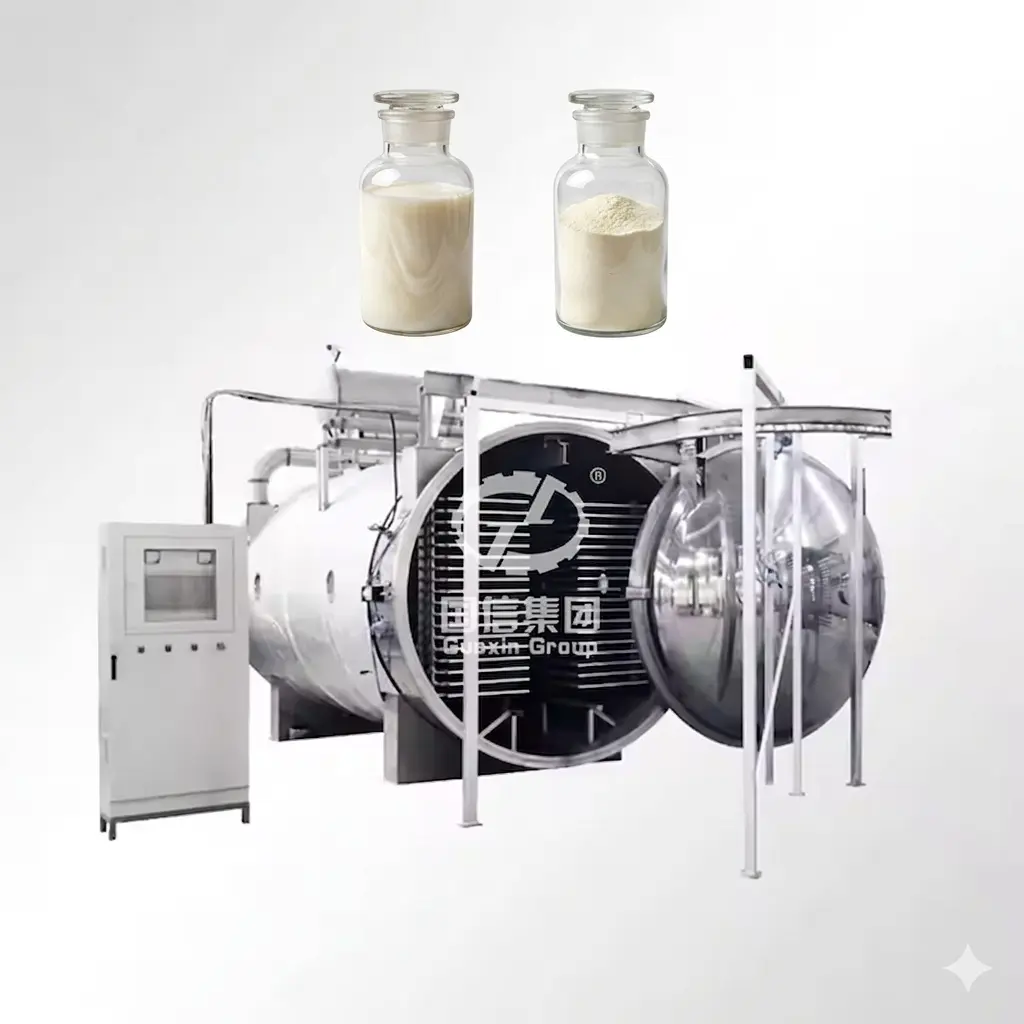
Milk Powder Drying – Parameters for Consistent Final Moisture and Functional Properties
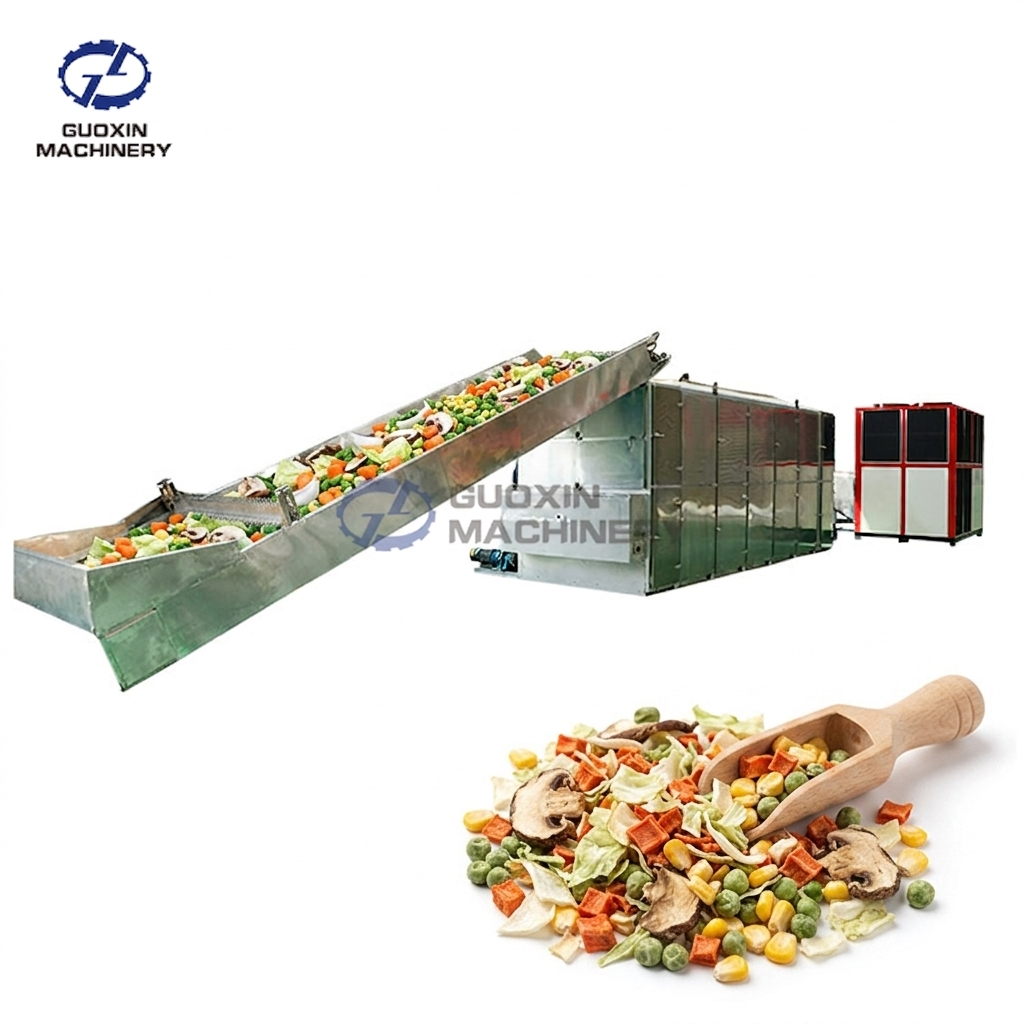
Dehydrated Vegetables for Instant Noodle Seasoning – Drying Parameters for Consistent Quality in Seasoning Packs
Sun-Dried Tomato Drying – Parameters for Industrial Production of Consistent Tomato Slices
Drying Coffee Beans, Cocoa Nibs and Instant Coffee Powder