© Henan Guoxin Machinery Manufacturing Co., Ltd. All Rights Reserved.



Release time:2026-05-20
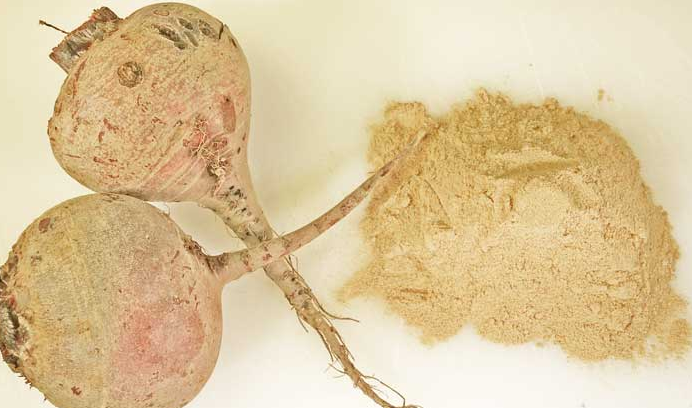
Processing high-altitude Peruvian maca roots (Lepidium meyenii) into export-grade slices or fine botanical powder requires rapid moisture extraction coupled with strict microbial control.
Fresh maca roots contain an initial moisture level of 65% to 75% within a dense, fibrous starch core.
Traditional convective hot-air drying methods require up to 48 hours to pull moisture down to the safe export threshold of 10% to 12%, exposing the high-sugar, protein-rich root matrix to severe risks of internal fermentation, mold development, and heavy degradation of heat-sensitive bioactive compounds (macamides, macaenes, and glucosinolates).
We integrated continuous industrial microwave drying and sterilization tunnels designed specifically for premium root crops. By applying volumetric electromagnetic fields, our systems achieve cell-level dehydration and pasteurization within minutes, eliminating the need for toxic chemical fumigation (such as ethylene oxide or methyl bromide) and ensuring full compliance with international pharmaceutical and organic food import protocols.
Premium commercial maca is cultivated exclusively on the high-altitude Andean plateaus of Peru (specifically the Junín plateau), situated at elevations between 4,000 and 4,500 meters. The crop thrives in mineral-dense volcanic soils subjected to extreme diurnal temperature fluctuations and intense ultraviolet radiation. These harsh growing conditions force the plant to synthesize dense concentrations of secondary metabolites, functional starches, and complex glucosinolates within its hypocotyl root.
When this raw material enters an industrial facility, its high tissue density presents a major processing barrier. The fibrous outer layers act as an insulation barrier against external heat transfer. If hot-air processing is applied, the slow migration of water through the dense root core triggers enzymatic browning and hydrolytic rancidity, destroying the characteristic pungent aroma and turning the interior of the root sour before drying finishes.
Traditional convective dryers rely on surface-to-core conduction, which alters the biochemical composition of dense root crops. Guoxin’s industrial microwave tunnels resolve these issues by altering the thermodynamic mechanism of mass transfer.
When dense maca slices are subjected to external hot air, surface moisture evaporates faster than core moisture can migrate outward. This causes the exterior starch matrix to collapse and gelatinize, forming an impermeable crust known as case hardening. This trapped moisture inside guarantees future batch spoilage.
Our continuous microwave tunnels utilize a 2450 MHz Volumetric Electromagnetic Field Vector. Instead of heating the air around the product, the microwave energy penetrates directly into the core of the maca slices, causing the polar water molecules throughout the entire root structure to rotate millions of times per second. This friction generates immediate, uniform internal heat, creating a positive vapor pressure gradient that drives moisture outward from the core to the surface at a cellular level. Dehydration that previously required days is completed in 8 to 15 minutes, entirely bypassing the case hardening phase.
Import regulations in North America and Europe enforce strict microbial limits on imported root powders regarding total plate count (TPC), yeasts, molds, and salmonella. Traditional steam sterilization wets the pre-dried material again, requiring a second drying cycle that destroys heat-sensitive macamides, while chemical gas fumigation leaves toxic residues that disqualify the product from organic certification.
The Engineering Solution:
The continuous microwave line acts simultaneously as a Thermal and Non-Thermal Sterilization System. The electromagnetic field penetrates the microbial cells, causing rapid localized heating of their internal water content alongside direct structural disruption of microbial cell membranes. This achieves a verified 5-log reduction in bacterial and spore counts within the same drying cycle. Because the total processing window is brief, the core product temperature is tightly controlled via PLC infrared sensors, preserving over 90% of native glucosinolates and active macamides.
The matrix below defines the engineered operational configurations for Guoxin continuous industrial microwave drying and sterilization tunnels optimized for high-value root processing operations.
| Operational Parameter | GX-MW-60kW Tunnels | GX-MW-100kW Plant | GX-MW-200kW Complex |
| Hourly Output Range (Slices) | 60 kg/h to 120 kg/h | 150 kg/h to 300 kg/h | 400 kg/h to 800 kg/h+ |
| Magnetron Frequency Array | 2450 MHz(± 50 MHz) | 2450 MHz(± 50 MHz) | 915 MHz / 2450 MHz Industrial |
| Microwave Power Supply | 60 kW (Adjustable) | 100 kW (Adjustable) | 200 kW (Adjustable) |
| Conveyor Belt Width | 800 mm | 1,000 mm | 1,200 mm |
| Total Tunnel Enclosure Length | 12 Meters | 16 Meters | 24 Meters |
| Conveyor Bed Construction | Food-Grade Teflon / PP Mesh | Food-Grade Teflon / PP Mesh | Heavy-Duty Non-Stick Industrial |
| Thermal Monitoring System | Multi-Point Infrared Array | Multi-Point Infrared Array | Multi-Point Infrared Array |
| Microwave Leakage Standard | < 1 mW/cm² (Exceeds FDA) | < 1 mW/cm² (Exceeds FDA) | < 1 mW/cm² (Exceeds FDA) |
| Automation Architecture | Siemens PLC / Touchscreen HMI | Siemens PLC / Touchscreen HMI | Full Siemens PLC / SCADA Ready |
In high-value botanical processing, energy application efficiency determines the net operational margin per kilogram of finished extract or powder.
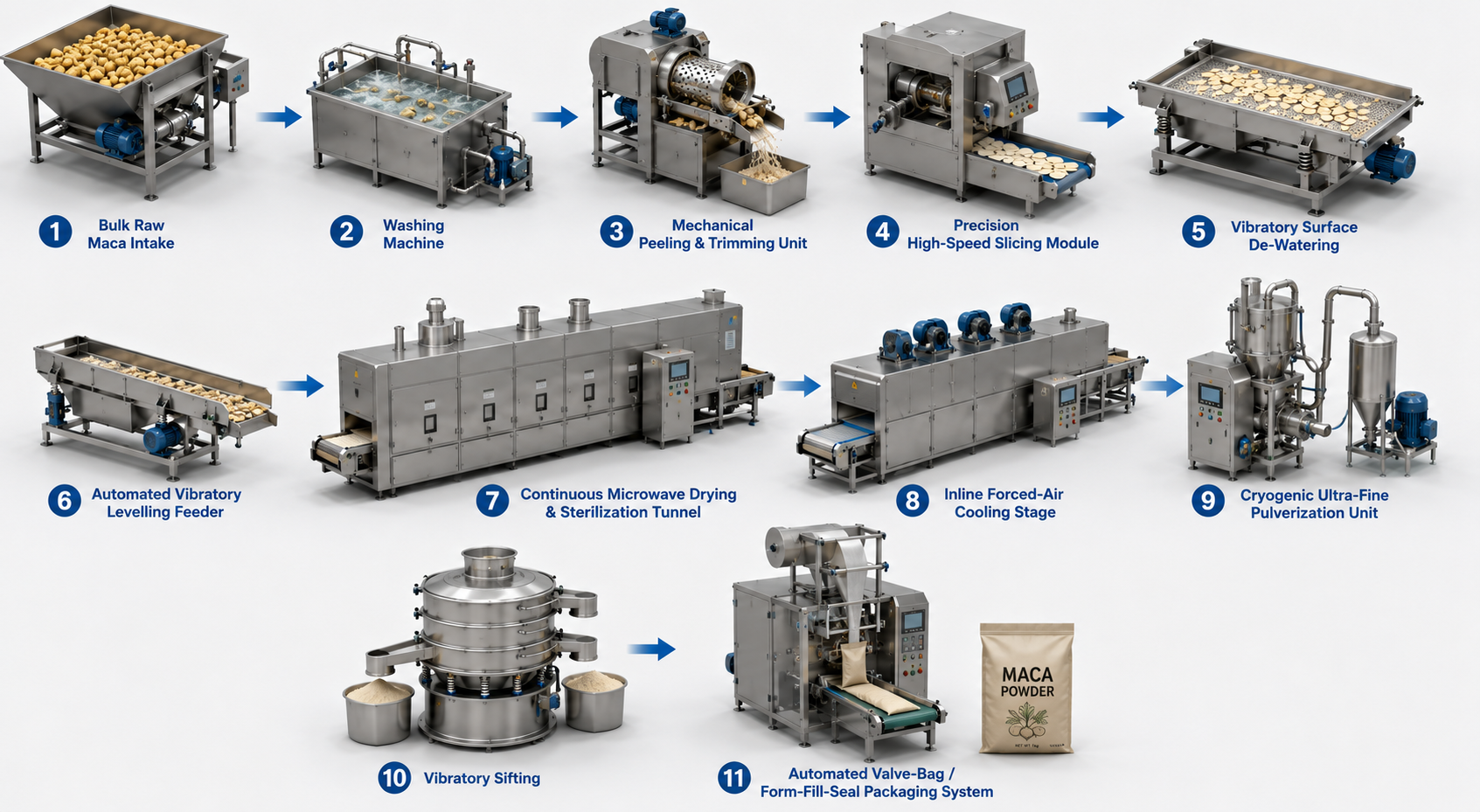
Industrial spice and root processors require comprehensive, single-source factory engineering to ensure balanced material flow and prevent cross-contamination between slicing and pulverizing stages. Guoxin Machinery designs, manufactures, and installs full turnkey (EPC) processing lines:
Bulk Raw Maca Intake] → [Washing Machine] → [Mechanical Peeling & Trimming Unit] → [Precision High-Speed Slicing Module] → [Vibratory Surface De-Watering] → [Automated Vibratory Levelling Feeder] → [ Continuous Microwave Drying & Sterilization Tunnel] → [Inline Forced-Air Cooling Stage] → [Cryogenic Ultra-Fine Pulverization Unit] → [Vibratory Sifting ] → [Automated Valve-Bag / Form-Fill-Seal Packaging System]
Q1: How do I select the appropriate microwave power output and model for my factory?
A: Selection is calculated based on your targeted hourly throughput and the physical form of your input material (whole roots, thick slices, or pre-milled damp granulated material). Water absorbs microwave energy at a known thermodynamic constant. To extract 100 kilograms of water from dense maca slices within one hour, a minimum of approximately 75kW of direct microwave power must be applied to the material bed. To ensure an operational safety buffer and account for variations in initial root density, we recommend our GX-MW-100kW Plant for facilities targeted at medium-scale continuous export production.
Q2: What is the recommended factory layout for ensuring international bio-safety compliance?
A: To satisfy international pharmaceutical and food-grade cleanroom standards, the facility must be divided into three distinct operational barriers. The wet preparation equipment (washing, peeling, slicing) is anchored in the Raw Material Wet Zone. The industrial microwave drying & sterilization machine serves as the continuous thermodynamic wall transition. Because the material emerges from the tunnel completely sterile, the discharge end must exit directly into a positive-pressure, HEPA-filtered Class 100,000 Clean Room Area dedicated exclusively to cooling, cryogenic milling, and automated packaging, ensuring zero exposure to ambient airborne pathogens.
Q3: What are the capital expenditure requirements and verified ROI payback windows for this system?
A: While the initial capital cost (CapEx) of an industrial microwave system is higher than basic agricultural hot-air trays, the operational cost savings provide a highly compressed payback window. By combining drying and sterilization into a single automated process that takes minutes instead of days, factory footprint is reduced by 80% and manual labor dependencies drop to just 1 to 2 operators. When factored alongside the 60% to 70% reduction in energy utility expenditures and the premium prices commanded by certified pathogen-free, high-macamide organic powders, commercial processors typically achieve full capital investment amortization within 12 to 18 months of commissioning.
Q4: How does the system ensure operational safety regarding microwave emissions?
A: Our continuous industrial tunnels are engineered with advanced, multi-stage structural suppression chambers at both the inlet and outlet gates. These microwave suppression zones utilize geometry-tuned chokes and advanced absorbing materials to trap stray electromagnetic waves completely. The entire enclosure is built with heavy-duty, double-shielded inspection panels equipped with automatic safety-interlock switches that instantly terminate magnetron power if a door is opened during operation. Verified leakage levels remain below 1mW/cm^2 measured at any point, comfortably exceeding FDA, OSHA, and European CE safety directives.
Henan Guoxin Machinery partners with international botanical brands, pharmaceutical processors, and agricultural cooperatives to validate processing performance metrics before equipment fabrication begins.
Commercial Durian Dehydration: Preserving Quality with Heat Pump Technology
Milk Powder Drying – Parameters for Consistent Final Moisture and Functional Properties
Dehydrated Vegetables for Instant Noodle Seasoning – Drying Parameters for Consistent Quality in Seasoning Packs
Sun-Dried Tomato Drying – Parameters for Industrial Production of Consistent Tomato Slices
Drying Coffee Beans, Cocoa Nibs and Instant Coffee Powder